
Why Kitchen Cleaning Tips from Professional Cleaners Actually Work
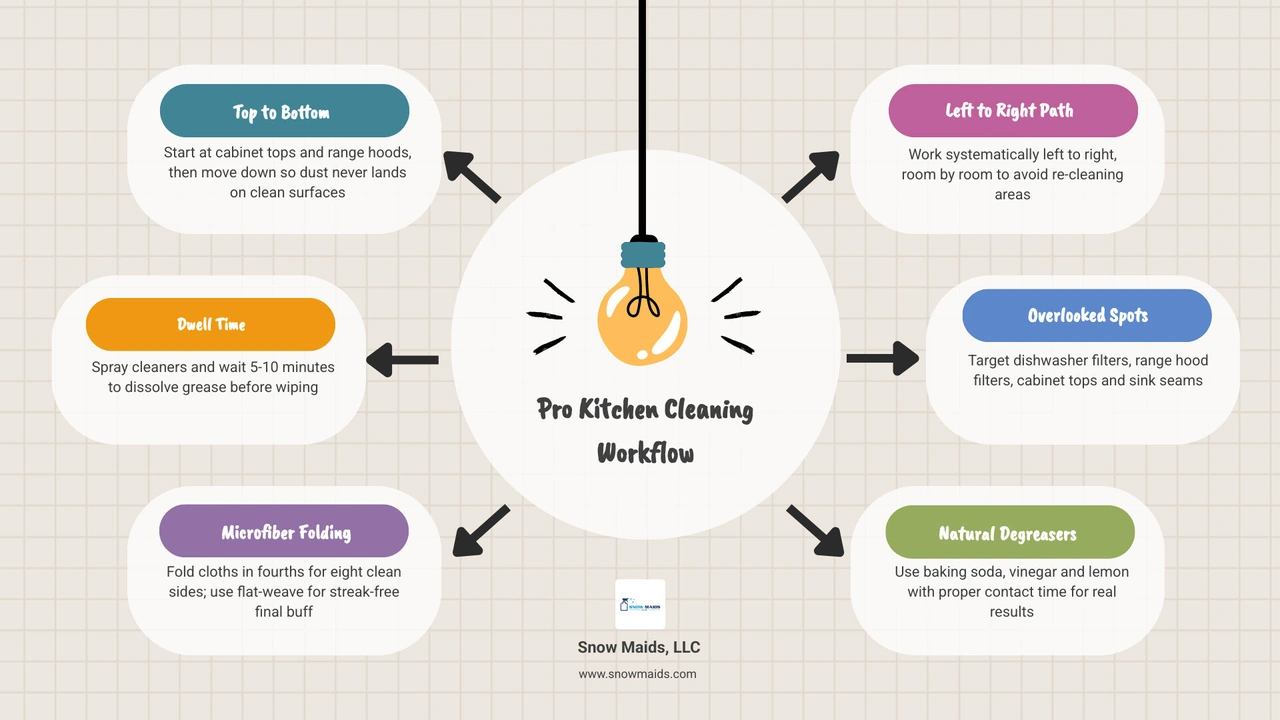
The best kitchen cleaning tips from professional cleaners can cut your cleaning time in half — and help you get results that actually last. Here's a quick summary of what the pros recommend:
- Clean top to bottom — always start high (cabinet tops, range hood) and work down to the floors so falling dust never lands on already-clean surfaces
- Let cleaners dwell — spray surfaces and wait 5-10 minutes before wiping; this dissolves grease so you barely have to scrub
- Use microfiber cloths — fold in fourths for eight clean sides; use flat-weave for final streak-free buffing
- Follow a path — work left to right, room by room, so you never re-clean the same spot twice
- Hit the overlooked spots — dishwasher filters, range hood filters, cabinet tops, and sink seams collect the most hidden grime
- Use natural degreasers — baking soda, vinegar, and lemon do real work when given proper contact time
- Build daily micro-habits — 5-15 minutes a day prevents the weekend deep-clean spiral
The kitchen is the hardest-working room in any home. Between daily cooking, grease buildup, and constantly used appliances, the mess compounds fast — and most of us don't have time to keep up with it. If you're managing a busy household in the Denver Metro Area, that feeling of a kitchen that's never quite clean is exhausting.
The good news? Professional cleaners don't work harder than you — they work smarter. Their results come down to the right sequence, the right tools, and a few techniques most people have never tried.
The Professional Workflow: Top-to-Bottom Efficiency
If you have ever spent an hour scrubbing your counters only to realize the tops of your cabinets are covered in dust that is now falling onto your clean surfaces, you’ve experienced the frustration of an inefficient workflow. Professional cleaners avoid this by following two golden rules: top-to-bottom and left-to-right.
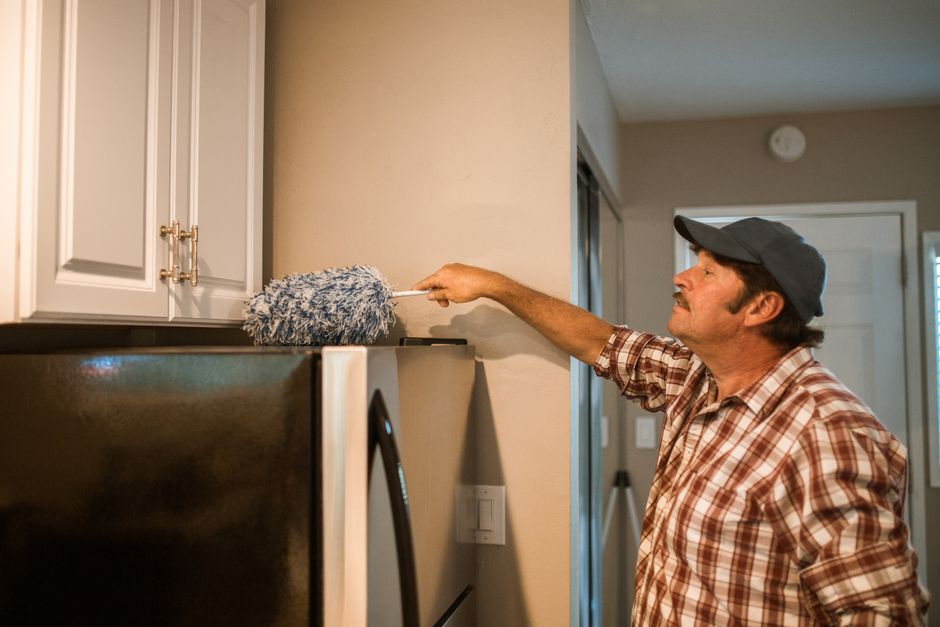
Gravity is a cleaner's best friend—or their worst enemy. By starting at the highest point in the kitchen, such as the ceiling fans, light fixtures, and the tops of the upper cabinets, any dust or debris that is dislodged falls downward. As you work your way down to the counters and finally the floors, you are systematically removing that debris rather than moving it around.
High dusting is a critical first step. Pros often use extendable magnetic dusters to reach the corners of the ceiling and the tops of tall pantry cabinets. This ensures that airborne particles are captured before you start wet cleaning. To understand the full scope of this process, you can see What Happens During Professional Deep House Clean to see how we tackle every layer of the home.
Kitchen cleaning tips from professional cleaners for faster results
Speed isn't about rushing; it's about movement. One of the most effective kitchen cleaning tips from professional cleaners is the "two-hand rule." This means one hand is always working (wiping, scrubbing, or dusting) while the other hand holds the spray bottle or a fresh cloth. This prevents the constant "reaching and resetting" that adds minutes to every task.
Efficiency also comes down to how you organize your gear. Professional cleaners use cleaning caddies to keep all their essential sprays and tools within arm's reach. Instead of walking back and forth to the under-sink cabinet, the caddy moves with you. We also recommend "task bundling"—spraying all your surfaces at once to let them soak (more on that later) while you tackle a different task, like emptying the trash or loading the dishwasher.
When you adopt a room-by-room approach rather than jumping between the kitchen and the living room, you stay focused and finish faster. For many homeowners, the choice between Professional House Maids vs DIY Cleaning comes down to whether they want to spend their entire Saturday on these sequences or hand them off to experts who have the rhythm down to a science.
Essential Tools and Kitchen Cleaning Tips from Professional Cleaners
The secret to a professional finish isn't always a "magic" chemical; it is often the cloth. Microfiber is the industry standard because its dense fibers grab and trap dirt instead of just smearing it around.
Pros use a specific folding technique: fold a microfiber cloth in half, then in half again. This gives you eight clean "sides" to work with. Once one side is dirty, you simply flip to a fresh side. This prevents cross-contamination and ensures you aren't just wiping grease from one counter onto another.
For different surfaces, you need different textures:
- All-purpose microfiber: Good for general wiping and dusting.
- Flat-weave towels: These look like silk or glass cloths and are essential for final buffing to prevent streaks.
- Scrub brushes: Small, stiff brushes (or even old toothbrushes) are needed for the seams where the sink meets the counter.
When it comes to products, simplicity is key. A pH-neutral cleaner is safest for natural stone like granite or marble to avoid etching. For tougher jobs, many pros rely on Bar Keepers Friend—a mild acidic cleaner that works wonders on stainless steel sinks and burnt-on stove messes. Understanding How Professional Cleaners Deliver a Deeper Clean Than DIY often starts with these professional-grade tools.
Achieving a streak-free finish on stainless steel and glass
Stainless steel is notoriously difficult to keep smudge-free, especially in busy households in Castle Rock or Parker. The pro trick? Always wipe with the grain. If you look closely at your appliances, you’ll see faint horizontal or vertical lines. Wiping in that direction prevents cleaning residue from getting trapped in the "valves" of the metal.
For a final shine, use a few drops of olive oil on a dry microfiber cloth and buff it into the surface. This creates a protective barrier that resists fingerprints. On glass cooktops, the "wow" factor comes from using a razor scraper on a wet surface to gently lift burnt-on food without scratching the glass. You can find more specific advice on this in our Deep Maid Service Kitchens Lakewood Tips guide.
Master the Art of Dwell Time and Natural Degreasing
If you find yourself scrubbing until your arms ache, you are likely skipping a crucial step: dwell time. This is the period a cleaning product needs to sit on a surface to chemically break down grease and grime.
Professional cleaners typically spray a surface and wait 5-10 minutes before touching it. During this time, the surfactants in the cleaner are doing the hard work for you. For heavy grease on stove backsplashes, a degreaser needs that contact time to liquify the oils.
For those who prefer a greener approach, natural ingredients are incredibly effective when used correctly. A baking soda paste (baking soda mixed with a little water) is a powerhouse for oven interiors. Apply it, let it sit for at least 15-20 minutes (or even overnight for deep cleans), and the grease will wipe away with a damp cloth. Vinegar and lemon are excellent for breaking down hard water stains around faucets. If you’re interested in an eco-friendly home, check out these Deep Eco Kitchen Cleaning Lakewood Tips.
Kitchen cleaning tips from professional cleaners for stubborn grease
The range hood filter is often the stickiest spot in the kitchen. Instead of scrubbing it, pros use a soak technique. Boiling water mixed with baking soda can help float the grease right off the metal mesh. For stove burners that have seen better days, an overnight soak in a sealed bag with a small amount of ammonia can eliminate the need for scrubbing entirely—just be sure to rinse them thoroughly in a well-ventilated area the next morning.
Another pro hack involves the tops of your cabinets. Because grease rises with steam during cooking, it settles on high surfaces and creates a sticky dust-trap. After a deep clean, line the tops of your cabinets with wax paper. Next time you clean, you simply roll up the greasy paper and replace it—no scrubbing required! This is the kind of detail we focus on in our Deep Maid Service for Kitchens in Golden Co offerings.
Sanitizing Overlooked Areas and Preventing Cross-Contamination
A kitchen can look clean but still harbor odors and bacteria in "hidden" spots. The dishwasher filter is a prime example. Most people don't realize their dishwasher has a filter that needs to be twisted out and rinsed monthly. If your dishes are coming out cloudy or there is a lingering musty smell, the filter is likely clogged with a biofilm of old food and soap scum.
Coffee makers are another culprit. Statistics show that 50% of household coffee makers contain yeast and mold. To fix this, run a cycle with a mixture of vinegar and water once a month, followed by two cycles of plain water to descale the internal heating elements.
Garbage disposals and trash cans also need regular attention to prevent odors from taking over your Denver area home. Dropping a few lemon slices or a tablespoon of baking soda into the disposal can freshen it instantly. For trash cans, pros recommend cleaning the interior with a disinfectant and letting it sit for several minutes before wiping to kill odor-causing bacteria. For more on the "deep" side of things, see Kitchen Deep Cleaning for Spotless Homes.
Maintaining hygiene and odor control
To prevent cross-contamination, professional cleaners use a color-coding system for their cloths—for example, blue for glass, yellow for counters, and red for high-risk areas like bathrooms. At home, you can achieve this by cutting the corner off a sponge once it’s no longer "kitchen-safe" so you know it’s now only for utility cleaning (like the trash can or floor).
It’s also important to remember that a standard wash cycle isn't always enough to remove infectious viruses from rags and sponges. Pros recommend replacing sponges frequently and washing cleaning cloths on a high-heat "sanitize" cycle. This is a principle we carry over from our Bathroom Cleaning Tips from Professional Cleaners to ensure your entire home is truly hygienic.
Daily Habits to Maintain a Professional Level of Clean
The difference between a kitchen that always looks great and one that only looks clean once a week is a set of small, daily habits. Professional cleaners suggest the "two-minute rule": if a task takes less than two minutes (like wiping a spill or putting a dish in the dishwasher), do it immediately.
Here is a checklist of daily habits that keep the kitchen looking sharp:
- The Countertop Wipe: Use a spray bottle of diluted dish soap to wipe counters after every meal.
- Sink Reset: Never go to bed with a full sink. A clean, dry sink makes the whole kitchen look better.
- Stovetop Maintenance: Wipe the stove while it’s still warm (but not hot!) so grease doesn't have a chance to harden.
- Trash Management: Empty the trash before it overflows, especially if it contains food scraps that will smell by morning.
- The Refrigerator Reset: Quickly check for expired items or spills before you take the trash out.
By spending just 5-15 minutes a day on these tasks, you prevent the "mountain" of mess that usually requires a four-hour deep clean. For more localized advice, our Deep Maid Service for Kitchens in Golden Co page offers great insights into maintaining these standards.
Frequently Asked Questions about Kitchen Cleaning
How often should I clean my dishwasher filter?
You should check and clean your dishwasher filter at least once a month. If you run your dishwasher daily or don't pre-rinse your dishes, you may need to do it more often. Signs that it's time for a clean include cloudy glassware, food particles left on "clean" dishes, or a lingering odor inside the machine. To clean it, simply twist it out, rinse it under hot water, and use a soft brush with dish soap to remove any slimy biofilm.
What is the best way to clean a microwave without chemicals?
Steam cleaning is the most effective, chemical-free method. Place a bowl of water with several lemon slices or a few drops of lemon essential oil inside. Microwave on high for 5 minutes, then let it sit for another 2-3 minutes without opening the door. The steam will loosen all the stuck-on food splatters, allowing you to simply wipe them away with a microfiber cloth.
Why do professionals vacuum before mopping?
Vacuuming (or sweeping) before mopping is essential because it removes loose hair, crumbs, and airborne particles. If you skip this step and go straight to mopping, you create a "streaky paste" of wet dust and grime that you simply move around the floor. Vacuuming ensures that the mop only has to deal with stuck-on stains and sanitizing, leading to a much cleaner, streak-free finish.
Conclusion
Achieving a professional-level clean in your kitchen doesn't require 20 different products or a whole weekend of scrubbing. By following the kitchen cleaning tips from professional cleaners—like cleaning top-to-bottom, respecting dwell time, and using the right microfiber techniques—you can maintain a spotless home with much less effort.
At Snow Maids, LLC, we know that your time is your most valuable resource. We provide tailored residential cleaning services across Castle Rock, Centennial, Denver, Highlands Ranch, and the surrounding areas. Our mission is to deliver a "squeaky clean" result that fits your individual routine, giving you back the hours you’d otherwise spend scrubbing.
If you’re ready to experience a kitchen that truly shines without doing the heavy lifting yourself, we’re here to help. Visit us at www.snowmaids.com/cleaning to learn more about our professional services in the Denver Metro Area.
Why Kitchen Cleaning Tips from Professional Cleaners Actually Work
The best kitchen cleaning tips from professional cleaners can cut your cleaning time in half — and help you get results that actually last. Here's a quick summary of what the pros recommend:
- Clean top to bottom — always start high (cabinet tops, range hood) and work down to the floors so falling dust never lands on already-clean surfaces
- Let cleaners dwell — spray surfaces and wait 5-10 minutes before wiping; this dissolves grease so you barely have to scrub
- Use microfiber cloths — fold in fourths for eight clean sides; use flat-weave for final streak-free buffing
- Follow a path — work left to right, room by room, so you never re-clean the same spot twice
- Hit the overlooked spots — dishwasher filters, range hood filters, cabinet tops, and sink seams collect the most hidden grime
- Use natural degreasers — baking soda, vinegar, and lemon do real work when given proper contact time
- Build daily micro-habits — 5-15 minutes a day prevents the weekend deep-clean spiral
The kitchen is the hardest-working room in any home. Between daily cooking, grease buildup, and constantly used appliances, the mess compounds fast — and most of us don't have time to keep up with it. If you're managing a busy household in the Denver Metro Area, that feeling of a kitchen that's never quite clean is exhausting.
The good news? Professional cleaners don't work harder than you — they work smarter. Their results come down to the right sequence, the right tools, and a few techniques most people have never tried.

The Professional Workflow: Top-to-Bottom Efficiency

If you have ever spent an hour scrubbing your counters only to realize the tops of your cabinets are covered in dust that is now falling onto your clean surfaces, you’ve experienced the frustration of an inefficient workflow. Professional cleaners avoid this by following two golden rules: top-to-bottom and left-to-right.
Gravity is a cleaner's best friend—or their worst enemy. By starting at the highest point in the kitchen, such as the ceiling fans, light fixtures, and the tops of the upper cabinets, any dust or debris that is dislodged falls downward. As you work your way down to the counters and finally the floors, you are systematically removing that debris rather than moving it around.
High dusting is a critical first step. Pros often use extendable magnetic dusters to reach the corners of the ceiling and the tops of tall pantry cabinets. This ensures that airborne particles are captured before you start wet cleaning. To understand the full scope of this process, you can see What Happens During Professional Deep House Clean to see how we tackle every layer of the home.
Kitchen cleaning tips from professional cleaners for faster results
Speed isn't about rushing; it's about movement. One of the most effective kitchen cleaning tips from professional cleaners is the "two-hand rule." This means one hand is always working (wiping, scrubbing, or dusting) while the other hand holds the spray bottle or a fresh cloth. This prevents the constant "reaching and resetting" that adds minutes to every task.
Efficiency also comes down to how you organize your gear. Professional cleaners use cleaning caddies to keep all their essential sprays and tools within arm's reach. Instead of walking back and forth to the under-sink cabinet, the caddy moves with you. We also recommend "task bundling"—spraying all your surfaces at once to let them soak (more on that later) while you tackle a different task, like emptying the trash or loading the dishwasher.
When you adopt a room-by-room approach rather than jumping between the kitchen and the living room, you stay focused and finish faster. For many homeowners, the choice between Professional House Maids vs DIY Cleaning comes down to whether they want to spend their entire Saturday on these sequences or hand them off to experts who have the rhythm down to a science.
Essential Tools and Kitchen Cleaning Tips from Professional Cleaners
The secret to a professional finish isn't always a "magic" chemical; it is often the cloth. Microfiber is the industry standard because its dense fibers grab and trap dirt instead of just smearing it around.
Pros use a specific folding technique: fold a microfiber cloth in half, then in half again. This gives you eight clean "sides" to work with. Once one side is dirty, you simply flip to a fresh side. This prevents cross-contamination and ensures you aren't just wiping grease from one counter onto another.
For different surfaces, you need different textures:
- All-purpose microfiber: Good for general wiping and dusting.
- Flat-weave towels: These look like silk or glass cloths and are essential for final buffing to prevent streaks.
- Scrub brushes: Small, stiff brushes (or even old toothbrushes) are needed for the seams where the sink meets the counter.
When it comes to products, simplicity is key. A pH-neutral cleaner is safest for natural stone like granite or marble to avoid etching. For tougher jobs, many pros rely on Bar Keepers Friend—a mild acidic cleaner that works wonders on stainless steel sinks and burnt-on stove messes. Understanding How Professional Cleaners Deliver a Deeper Clean Than DIY often starts with these professional-grade tools.
Achieving a streak-free finish on stainless steel and glass
Stainless steel is notoriously difficult to keep smudge-free, especially in busy households in Castle Rock or Parker. The pro trick? Always wipe with the grain. If you look closely at your appliances, you’ll see faint horizontal or vertical lines. Wiping in that direction prevents cleaning residue from getting trapped in the "valves" of the metal.
For a final shine, use a few drops of olive oil on a dry microfiber cloth and buff it into the surface. This creates a protective barrier that resists fingerprints. On glass cooktops, the "wow" factor comes from using a razor scraper on a wet surface to gently lift burnt-on food without scratching the glass. You can find more specific advice on this in our Deep Maid Service Kitchens Lakewood Tips guide.
Master the Art of Dwell Time and Natural Degreasing
If you find yourself scrubbing until your arms ache, you are likely skipping a crucial step: dwell time. This is the period a cleaning product needs to sit on a surface to chemically break down grease and grime.
Professional cleaners typically spray a surface and wait 5-10 minutes before touching it. During this time, the surfactants in the cleaner are doing the hard work for you. For heavy grease on stove backsplashes, a degreaser needs that contact time to liquify the oils.
For those who prefer a greener approach, natural ingredients are incredibly effective when used correctly. A baking soda paste (baking soda mixed with a little water) is a powerhouse for oven interiors. Apply it, let it sit for at least 15-20 minutes (or even overnight for deep cleans), and the grease will wipe away with a damp cloth. Vinegar and lemon are excellent for breaking down hard water stains around faucets. If you’re interested in an eco-friendly home, check out these Deep Eco Kitchen Cleaning Lakewood Tips.
Kitchen cleaning tips from professional cleaners for stubborn grease
The range hood filter is often the stickiest spot in the kitchen. Instead of scrubbing it, pros use a soak technique. Boiling water mixed with baking soda can help float the grease right off the metal mesh. For stove burners that have seen better days, an overnight soak in a sealed bag with a small amount of ammonia can eliminate the need for scrubbing entirely—just be sure to rinse them thoroughly in a well-ventilated area the next morning.
Another pro hack involves the tops of your cabinets. Because grease rises with steam during cooking, it settles on high surfaces and creates a sticky dust-trap. After a deep clean, line the tops of your cabinets with wax paper. Next time you clean, you simply roll up the greasy paper and replace it—no scrubbing required! This is the kind of detail we focus on in our Deep Maid Service for Kitchens in Golden Co offerings.
Sanitizing Overlooked Areas and Preventing Cross-Contamination
A kitchen can look clean but still harbor odors and bacteria in "hidden" spots. The dishwasher filter is a prime example. Most people don't realize their dishwasher has a filter that needs to be twisted out and rinsed monthly. If your dishes are coming out cloudy or there is a lingering musty smell, the filter is likely clogged with a biofilm of old food and soap scum.
Coffee makers are another culprit. Statistics show that 50% of household coffee makers contain yeast and mold. To fix this, run a cycle with a mixture of vinegar and water once a month, followed by two cycles of plain water to descale the internal heating elements.
Garbage disposals and trash cans also need regular attention to prevent odors from taking over your Denver area home. Dropping a few lemon slices or a tablespoon of baking soda into the disposal can freshen it instantly. For trash cans, pros recommend cleaning the interior with a disinfectant and letting it sit for several minutes before wiping to kill odor-causing bacteria. For more on the "deep" side of things, see Kitchen Deep Cleaning for Spotless Homes.
Maintaining hygiene and odor control
To prevent cross-contamination, professional cleaners use a color-coding system for their cloths—for example, blue for glass, yellow for counters, and red for high-risk areas like bathrooms. At home, you can achieve this by cutting the corner off a sponge once it’s no longer "kitchen-safe" so you know it’s now only for utility cleaning (like the trash can or floor).
It’s also important to remember that a standard wash cycle isn't always enough to remove infectious viruses from rags and sponges. Pros recommend replacing sponges frequently and washing cleaning cloths on a high-heat "sanitize" cycle. This is a principle we carry over from our Bathroom Cleaning Tips from Professional Cleaners to ensure your entire home is truly hygienic.
Daily Habits to Maintain a Professional Level of Clean
The difference between a kitchen that always looks great and one that only looks clean once a week is a set of small, daily habits. Professional cleaners suggest the "two-minute rule": if a task takes less than two minutes (like wiping a spill or putting a dish in the dishwasher), do it immediately.
Here is a checklist of daily habits that keep the kitchen looking sharp:
- The Countertop Wipe: Use a spray bottle of diluted dish soap to wipe counters after every meal.
- Sink Reset: Never go to bed with a full sink. A clean, dry sink makes the whole kitchen look better.
- Stovetop Maintenance: Wipe the stove while it’s still warm (but not hot!) so grease doesn't have a chance to harden.
- Trash Management: Empty the trash before it overflows, especially if it contains food scraps that will smell by morning.
- The Refrigerator Reset: Quickly check for expired items or spills before you take the trash out.
By spending just 5-15 minutes a day on these tasks, you prevent the "mountain" of mess that usually requires a four-hour deep clean. For more localized advice, our Deep Maid Service for Kitchens in Golden Co page offers great insights into maintaining these standards.
Frequently Asked Questions about Kitchen Cleaning
How often should I clean my dishwasher filter?
You should check and clean your dishwasher filter at least once a month. If you run your dishwasher daily or don't pre-rinse your dishes, you may need to do it more often. Signs that it's time for a clean include cloudy glassware, food particles left on "clean" dishes, or a lingering odor inside the machine. To clean it, simply twist it out, rinse it under hot water, and use a soft brush with dish soap to remove any slimy biofilm.
What is the best way to clean a microwave without chemicals?
Steam cleaning is the most effective, chemical-free method. Place a bowl of water with several lemon slices or a few drops of lemon essential oil inside. Microwave on high for 5 minutes, then let it sit for another 2-3 minutes without opening the door. The steam will loosen all the stuck-on food splatters, allowing you to simply wipe them away with a microfiber cloth.
Why do professionals vacuum before mopping?
Vacuuming (or sweeping) before mopping is essential because it removes loose hair, crumbs, and airborne particles. If you skip this step and go straight to mopping, you create a "streaky paste" of wet dust and grime that you simply move around the floor. Vacuuming ensures that the mop only has to deal with stuck-on stains and sanitizing, leading to a much cleaner, streak-free finish.
Conclusion
Achieving a professional-level clean in your kitchen doesn't require 20 different products or a whole weekend of scrubbing. By following the kitchen cleaning tips from professional cleaners—like cleaning top-to-bottom, respecting dwell time, and using the right microfiber techniques—you can maintain a spotless home with much less effort.
At Snow Maids, LLC, we know that your time is your most valuable resource. We provide tailored residential cleaning services across Castle Rock, Centennial, Denver, Highlands Ranch, and the surrounding areas. Our mission is to deliver a "squeaky clean" result that fits your individual routine, giving you back the hours you’d otherwise spend scrubbing.
If you’re ready to experience a kitchen that truly shines without doing the heavy lifting yourself, we’re here to help. Visit us at www.snowmaids.com/cleaning to learn more about our professional services in the Denver Metro Area.
Why Kitchen Cleaning Tips from Professional Cleaners Actually Work
The best kitchen cleaning tips from professional cleaners can cut your cleaning time in half — and help you get results that actually last. Here's a quick summary of what the pros recommend:
- Clean top to bottom — always start high (cabinet tops, range hood) and work down to the floors so falling dust never lands on already-clean surfaces
- Let cleaners dwell — spray surfaces and wait 5-10 minutes before wiping; this dissolves grease so you barely have to scrub
- Use microfiber cloths — fold in fourths for eight clean sides; use flat-weave for final streak-free buffing
- Follow a path — work left to right, room by room, so you never re-clean the same spot twice
- Hit the overlooked spots — dishwasher filters, range hood filters, cabinet tops, and sink seams collect the most hidden grime
- Use natural degreasers — baking soda, vinegar, and lemon do real work when given proper contact time
- Build daily micro-habits — 5-15 minutes a day prevents the weekend deep-clean spiral
The kitchen is the hardest-working room in any home. Between daily cooking, grease buildup, and constantly used appliances, the mess compounds fast — and most of us don't have time to keep up with it. If you're managing a busy household in the Denver Metro Area, that feeling of a kitchen that's never quite clean is exhausting.
The good news? Professional cleaners don't work harder than you — they work smarter. Their results come down to the right sequence, the right tools, and a few techniques most people have never tried.

The Professional Workflow: Top-to-Bottom Efficiency

If you have ever spent an hour scrubbing your counters only to realize the tops of your cabinets are covered in dust that is now falling onto your clean surfaces, you’ve experienced the frustration of an inefficient workflow. Professional cleaners avoid this by following two golden rules: top-to-bottom and left-to-right.
Gravity is a cleaner's best friend—or their worst enemy. By starting at the highest point in the kitchen, such as the ceiling fans, light fixtures, and the tops of the upper cabinets, any dust or debris that is dislodged falls downward. As you work your way down to the counters and finally the floors, you are systematically removing that debris rather than moving it around.
High dusting is a critical first step. Pros often use extendable magnetic dusters to reach the corners of the ceiling and the tops of tall pantry cabinets. This ensures that airborne particles are captured before you start wet cleaning. To understand the full scope of this process, you can see What Happens During Professional Deep House Clean to see how we tackle every layer of the home.
Kitchen cleaning tips from professional cleaners for faster results
Speed isn't about rushing; it's about movement. One of the most effective kitchen cleaning tips from professional cleaners is the "two-hand rule." This means one hand is always working (wiping, scrubbing, or dusting) while the other hand holds the spray bottle or a fresh cloth. This prevents the constant "reaching and resetting" that adds minutes to every task.
Efficiency also comes down to how you organize your gear. Professional cleaners use cleaning caddies to keep all their essential sprays and tools within arm's reach. Instead of walking back and forth to the under-sink cabinet, the caddy moves with you. We also recommend "task bundling"—spraying all your surfaces at once to let them soak (more on that later) while you tackle a different task, like emptying the trash or loading the dishwasher.
When you adopt a room-by-room approach rather than jumping between the kitchen and the living room, you stay focused and finish faster. For many homeowners, the choice between Professional House Maids vs DIY Cleaning comes down to whether they want to spend their entire Saturday on these sequences or hand them off to experts who have the rhythm down to a science.
Essential Tools and Kitchen Cleaning Tips from Professional Cleaners
The secret to a professional finish isn't always a "magic" chemical; it is often the cloth. Microfiber is the industry standard because its dense fibers grab and trap dirt instead of just smearing it around.
Pros use a specific folding technique: fold a microfiber cloth in half, then in half again. This gives you eight clean "sides" to work with. Once one side is dirty, you simply flip to a fresh side. This prevents cross-contamination and ensures you aren't just wiping grease from one counter onto another.
For different surfaces, you need different textures:
- All-purpose microfiber: Good for general wiping and dusting.
- Flat-weave towels: These look like silk or glass cloths and are essential for final buffing to prevent streaks.
- Scrub brushes: Small, stiff brushes (or even old toothbrushes) are needed for the seams where the sink meets the counter.
When it comes to products, simplicity is key. A pH-neutral cleaner is safest for natural stone like granite or marble to avoid etching. For tougher jobs, many pros rely on Bar Keepers Friend—a mild acidic cleaner that works wonders on stainless steel sinks and burnt-on stove messes. Understanding How Professional Cleaners Deliver a Deeper Clean Than DIY often starts with these professional-grade tools.
Achieving a streak-free finish on stainless steel and glass
Stainless steel is notoriously difficult to keep smudge-free, especially in busy households in Castle Rock or Parker. The pro trick? Always wipe with the grain. If you look closely at your appliances, you’ll see faint horizontal or vertical lines. Wiping in that direction prevents cleaning residue from getting trapped in the "valves" of the metal.
For a final shine, use a few drops of olive oil on a dry microfiber cloth and buff it into the surface. This creates a protective barrier that resists fingerprints. On glass cooktops, the "wow" factor comes from using a razor scraper on a wet surface to gently lift burnt-on food without scratching the glass. You can find more specific advice on this in our Deep Maid Service Kitchens Lakewood Tips guide.
Master the Art of Dwell Time and Natural Degreasing
If you find yourself scrubbing until your arms ache, you are likely skipping a crucial step: dwell time. This is the period a cleaning product needs to sit on a surface to chemically break down grease and grime.
Professional cleaners typically spray a surface and wait 5-10 minutes before touching it. During this time, the surfactants in the cleaner are doing the hard work for you. For heavy grease on stove backsplashes, a degreaser needs that contact time to liquify the oils.
For those who prefer a greener approach, natural ingredients are incredibly effective when used correctly. A baking soda paste (baking soda mixed with a little water) is a powerhouse for oven interiors. Apply it, let it sit for at least 15-20 minutes (or even overnight for deep cleans), and the grease will wipe away with a damp cloth. Vinegar and lemon are excellent for breaking down hard water stains around faucets. If you’re interested in an eco-friendly home, check out these Deep Eco Kitchen Cleaning Lakewood Tips.
Kitchen cleaning tips from professional cleaners for stubborn grease
The range hood filter is often the stickiest spot in the kitchen. Instead of scrubbing it, pros use a soak technique. Boiling water mixed with baking soda can help float the grease right off the metal mesh. For stove burners that have seen better days, an overnight soak in a sealed bag with a small amount of ammonia can eliminate the need for scrubbing entirely—just be sure to rinse them thoroughly in a well-ventilated area the next morning.
Another pro hack involves the tops of your cabinets. Because grease rises with steam during cooking, it settles on high surfaces and creates a sticky dust-trap. After a deep clean, line the tops of your cabinets with wax paper. Next time you clean, you simply roll up the greasy paper and replace it—no scrubbing required! This is the kind of detail we focus on in our Deep Maid Service for Kitchens in Golden Co offerings.
Sanitizing Overlooked Areas and Preventing Cross-Contamination
A kitchen can look clean but still harbor odors and bacteria in "hidden" spots. The dishwasher filter is a prime example. Most people don't realize their dishwasher has a filter that needs to be twisted out and rinsed monthly. If your dishes are coming out cloudy or there is a lingering musty smell, the filter is likely clogged with a biofilm of old food and soap scum.
Coffee makers are another culprit. Statistics show that 50% of household coffee makers contain yeast and mold. To fix this, run a cycle with a mixture of vinegar and water once a month, followed by two cycles of plain water to descale the internal heating elements.
Garbage disposals and trash cans also need regular attention to prevent odors from taking over your Denver area home. Dropping a few lemon slices or a tablespoon of baking soda into the disposal can freshen it instantly. For trash cans, pros recommend cleaning the interior with a disinfectant and letting it sit for several minutes before wiping to kill odor-causing bacteria. For more on the "deep" side of things, see Kitchen Deep Cleaning for Spotless Homes.
Maintaining hygiene and odor control
To prevent cross-contamination, professional cleaners use a color-coding system for their cloths—for example, blue for glass, yellow for counters, and red for high-risk areas like bathrooms. At home, you can achieve this by cutting the corner off a sponge once it’s no longer "kitchen-safe" so you know it’s now only for utility cleaning (like the trash can or floor).
It’s also important to remember that a standard wash cycle isn't always enough to remove infectious viruses from rags and sponges. Pros recommend replacing sponges frequently and washing cleaning cloths on a high-heat "sanitize" cycle. This is a principle we carry over from our Bathroom Cleaning Tips from Professional Cleaners to ensure your entire home is truly hygienic.
Daily Habits to Maintain a Professional Level of Clean
The difference between a kitchen that always looks great and one that only looks clean once a week is a set of small, daily habits. Professional cleaners suggest the "two-minute rule": if a task takes less than two minutes (like wiping a spill or putting a dish in the dishwasher), do it immediately.
Here is a checklist of daily habits that keep the kitchen looking sharp:
- The Countertop Wipe: Use a spray bottle of diluted dish soap to wipe counters after every meal.
- Sink Reset: Never go to bed with a full sink. A clean, dry sink makes the whole kitchen look better.
- Stovetop Maintenance: Wipe the stove while it’s still warm (but not hot!) so grease doesn't have a chance to harden.
- Trash Management: Empty the trash before it overflows, especially if it contains food scraps that will smell by morning.
- The Refrigerator Reset: Quickly check for expired items or spills before you take the trash out.
By spending just 5-15 minutes a day on these tasks, you prevent the "mountain" of mess that usually requires a four-hour deep clean. For more localized advice, our Deep Maid Service for Kitchens in Golden Co page offers great insights into maintaining these standards.
Frequently Asked Questions about Kitchen Cleaning
How often should I clean my dishwasher filter?
You should check and clean your dishwasher filter at least once a month. If you run your dishwasher daily or don't pre-rinse your dishes, you may need to do it more often. Signs that it's time for a clean include cloudy glassware, food particles left on "clean" dishes, or a lingering odor inside the machine. To clean it, simply twist it out, rinse it under hot water, and use a soft brush with dish soap to remove any slimy biofilm.
What is the best way to clean a microwave without chemicals?
Steam cleaning is the most effective, chemical-free method. Place a bowl of water with several lemon slices or a few drops of lemon essential oil inside. Microwave on high for 5 minutes, then let it sit for another 2-3 minutes without opening the door. The steam will loosen all the stuck-on food splatters, allowing you to simply wipe them away with a microfiber cloth.
Why do professionals vacuum before mopping?
Vacuuming (or sweeping) before mopping is essential because it removes loose hair, crumbs, and airborne particles. If you skip this step and go straight to mopping, you create a "streaky paste" of wet dust and grime that you simply move around the floor. Vacuuming ensures that the mop only has to deal with stuck-on stains and sanitizing, leading to a much cleaner, streak-free finish.
Conclusion
Achieving a professional-level clean in your kitchen doesn't require 20 different products or a whole weekend of scrubbing. By following the kitchen cleaning tips from professional cleaners—like cleaning top-to-bottom, respecting dwell time, and using the right microfiber techniques—you can maintain a spotless home with much less effort.
At Snow Maids, LLC, we know that your time is your most valuable resource. We provide tailored residential cleaning services across Castle Rock, Centennial, Denver, Highlands Ranch, and the surrounding areas. Our mission is to deliver a "squeaky clean" result that fits your individual routine, giving you back the hours you’d otherwise spend scrubbing.
If you’re ready to experience a kitchen that truly shines without doing the heavy lifting yourself, we’re here to help. Visit us at www.snowmaids.com/cleaning to learn more about our professional services in the Denver Metro Area.

Why Kitchen Cleaning Tips from Professional Cleaners Actually Work
The best kitchen cleaning tips from professional cleaners can cut your cleaning time in half — and help you get results that actually last. Here's a quick summary of what the pros recommend:
- Clean top to bottom — always start high (cabinet tops, range hood) and work down to the floors so falling dust never lands on already-clean surfaces
- Let cleaners dwell — spray surfaces and wait 5-10 minutes before wiping; this dissolves grease so you barely have to scrub
- Use microfiber cloths — fold in fourths for eight clean sides; use flat-weave for final streak-free buffing
- Follow a path — work left to right, room by room, so you never re-clean the same spot twice
- Hit the overlooked spots — dishwasher filters, range hood filters, cabinet tops, and sink seams collect the most hidden grime
- Use natural degreasers — baking soda, vinegar, and lemon do real work when given proper contact time
- Build daily micro-habits — 5-15 minutes a day prevents the weekend deep-clean spiral
The kitchen is the hardest-working room in any home. Between daily cooking, grease buildup, and constantly used appliances, the mess compounds fast — and most of us don't have time to keep up with it. If you're managing a busy household in the Denver Metro Area, that feeling of a kitchen that's never quite clean is exhausting.
The good news? Professional cleaners don't work harder than you — they work smarter. Their results come down to the right sequence, the right tools, and a few techniques most people have never tried.

The Professional Workflow: Top-to-Bottom Efficiency

If you have ever spent an hour scrubbing your counters only to realize the tops of your cabinets are covered in dust that is now falling onto your clean surfaces, you’ve experienced the frustration of an inefficient workflow. Professional cleaners avoid this by following two golden rules: top-to-bottom and left-to-right.
Gravity is a cleaner's best friend—or their worst enemy. By starting at the highest point in the kitchen, such as the ceiling fans, light fixtures, and the tops of the upper cabinets, any dust or debris that is dislodged falls downward. As you work your way down to the counters and finally the floors, you are systematically removing that debris rather than moving it around.
High dusting is a critical first step. Pros often use extendable magnetic dusters to reach the corners of the ceiling and the tops of tall pantry cabinets. This ensures that airborne particles are captured before you start wet cleaning. To understand the full scope of this process, you can see What Happens During Professional Deep House Clean to see how we tackle every layer of the home.
Kitchen cleaning tips from professional cleaners for faster results
Speed isn't about rushing; it's about movement. One of the most effective kitchen cleaning tips from professional cleaners is the "two-hand rule." This means one hand is always working (wiping, scrubbing, or dusting) while the other hand holds the spray bottle or a fresh cloth. This prevents the constant "reaching and resetting" that adds minutes to every task.
Efficiency also comes down to how you organize your gear. Professional cleaners use cleaning caddies to keep all their essential sprays and tools within arm's reach. Instead of walking back and forth to the under-sink cabinet, the caddy moves with you. We also recommend "task bundling"—spraying all your surfaces at once to let them soak (more on that later) while you tackle a different task, like emptying the trash or loading the dishwasher.
When you adopt a room-by-room approach rather than jumping between the kitchen and the living room, you stay focused and finish faster. For many homeowners, the choice between Professional House Maids vs DIY Cleaning comes down to whether they want to spend their entire Saturday on these sequences or hand them off to experts who have the rhythm down to a science.
Essential Tools and Kitchen Cleaning Tips from Professional Cleaners
The secret to a professional finish isn't always a "magic" chemical; it is often the cloth. Microfiber is the industry standard because its dense fibers grab and trap dirt instead of just smearing it around.
Pros use a specific folding technique: fold a microfiber cloth in half, then in half again. This gives you eight clean "sides" to work with. Once one side is dirty, you simply flip to a fresh side. This prevents cross-contamination and ensures you aren't just wiping grease from one counter onto another.
For different surfaces, you need different textures:
- All-purpose microfiber: Good for general wiping and dusting.
- Flat-weave towels: These look like silk or glass cloths and are essential for final buffing to prevent streaks.
- Scrub brushes: Small, stiff brushes (or even old toothbrushes) are needed for the seams where the sink meets the counter.
When it comes to products, simplicity is key. A pH-neutral cleaner is safest for natural stone like granite or marble to avoid etching. For tougher jobs, many pros rely on Bar Keepers Friend—a mild acidic cleaner that works wonders on stainless steel sinks and burnt-on stove messes. Understanding How Professional Cleaners Deliver a Deeper Clean Than DIY often starts with these professional-grade tools.
Achieving a streak-free finish on stainless steel and glass
Stainless steel is notoriously difficult to keep smudge-free, especially in busy households in Castle Rock or Parker. The pro trick? Always wipe with the grain. If you look closely at your appliances, you’ll see faint horizontal or vertical lines. Wiping in that direction prevents cleaning residue from getting trapped in the "valves" of the metal.
For a final shine, use a few drops of olive oil on a dry microfiber cloth and buff it into the surface. This creates a protective barrier that resists fingerprints. On glass cooktops, the "wow" factor comes from using a razor scraper on a wet surface to gently lift burnt-on food without scratching the glass. You can find more specific advice on this in our Deep Maid Service Kitchens Lakewood Tips guide.
Master the Art of Dwell Time and Natural Degreasing
If you find yourself scrubbing until your arms ache, you are likely skipping a crucial step: dwell time. This is the period a cleaning product needs to sit on a surface to chemically break down grease and grime.
Professional cleaners typically spray a surface and wait 5-10 minutes before touching it. During this time, the surfactants in the cleaner are doing the hard work for you. For heavy grease on stove backsplashes, a degreaser needs that contact time to liquify the oils.
For those who prefer a greener approach, natural ingredients are incredibly effective when used correctly. A baking soda paste (baking soda mixed with a little water) is a powerhouse for oven interiors. Apply it, let it sit for at least 15-20 minutes (or even overnight for deep cleans), and the grease will wipe away with a damp cloth. Vinegar and lemon are excellent for breaking down hard water stains around faucets. If you’re interested in an eco-friendly home, check out these Deep Eco Kitchen Cleaning Lakewood Tips.
Kitchen cleaning tips from professional cleaners for stubborn grease
The range hood filter is often the stickiest spot in the kitchen. Instead of scrubbing it, pros use a soak technique. Boiling water mixed with baking soda can help float the grease right off the metal mesh. For stove burners that have seen better days, an overnight soak in a sealed bag with a small amount of ammonia can eliminate the need for scrubbing entirely—just be sure to rinse them thoroughly in a well-ventilated area the next morning.
Another pro hack involves the tops of your cabinets. Because grease rises with steam during cooking, it settles on high surfaces and creates a sticky dust-trap. After a deep clean, line the tops of your cabinets with wax paper. Next time you clean, you simply roll up the greasy paper and replace it—no scrubbing required! This is the kind of detail we focus on in our Deep Maid Service for Kitchens in Golden Co offerings.
Sanitizing Overlooked Areas and Preventing Cross-Contamination
A kitchen can look clean but still harbor odors and bacteria in "hidden" spots. The dishwasher filter is a prime example. Most people don't realize their dishwasher has a filter that needs to be twisted out and rinsed monthly. If your dishes are coming out cloudy or there is a lingering musty smell, the filter is likely clogged with a biofilm of old food and soap scum.
Coffee makers are another culprit. Statistics show that 50% of household coffee makers contain yeast and mold. To fix this, run a cycle with a mixture of vinegar and water once a month, followed by two cycles of plain water to descale the internal heating elements.
Garbage disposals and trash cans also need regular attention to prevent odors from taking over your Denver area home. Dropping a few lemon slices or a tablespoon of baking soda into the disposal can freshen it instantly. For trash cans, pros recommend cleaning the interior with a disinfectant and letting it sit for several minutes before wiping to kill odor-causing bacteria. For more on the "deep" side of things, see Kitchen Deep Cleaning for Spotless Homes.
Maintaining hygiene and odor control
To prevent cross-contamination, professional cleaners use a color-coding system for their cloths—for example, blue for glass, yellow for counters, and red for high-risk areas like bathrooms. At home, you can achieve this by cutting the corner off a sponge once it’s no longer "kitchen-safe" so you know it’s now only for utility cleaning (like the trash can or floor).
It’s also important to remember that a standard wash cycle isn't always enough to remove infectious viruses from rags and sponges. Pros recommend replacing sponges frequently and washing cleaning cloths on a high-heat "sanitize" cycle. This is a principle we carry over from our Bathroom Cleaning Tips from Professional Cleaners to ensure your entire home is truly hygienic.
Daily Habits to Maintain a Professional Level of Clean
The difference between a kitchen that always looks great and one that only looks clean once a week is a set of small, daily habits. Professional cleaners suggest the "two-minute rule": if a task takes less than two minutes (like wiping a spill or putting a dish in the dishwasher), do it immediately.
Here is a checklist of daily habits that keep the kitchen looking sharp:
- The Countertop Wipe: Use a spray bottle of diluted dish soap to wipe counters after every meal.
- Sink Reset: Never go to bed with a full sink. A clean, dry sink makes the whole kitchen look better.
- Stovetop Maintenance: Wipe the stove while it’s still warm (but not hot!) so grease doesn't have a chance to harden.
- Trash Management: Empty the trash before it overflows, especially if it contains food scraps that will smell by morning.
- The Refrigerator Reset: Quickly check for expired items or spills before you take the trash out.
By spending just 5-15 minutes a day on these tasks, you prevent the "mountain" of mess that usually requires a four-hour deep clean. For more localized advice, our Deep Maid Service for Kitchens in Golden Co page offers great insights into maintaining these standards.
Frequently Asked Questions about Kitchen Cleaning
How often should I clean my dishwasher filter?
You should check and clean your dishwasher filter at least once a month. If you run your dishwasher daily or don't pre-rinse your dishes, you may need to do it more often. Signs that it's time for a clean include cloudy glassware, food particles left on "clean" dishes, or a lingering odor inside the machine. To clean it, simply twist it out, rinse it under hot water, and use a soft brush with dish soap to remove any slimy biofilm.
What is the best way to clean a microwave without chemicals?
Steam cleaning is the most effective, chemical-free method. Place a bowl of water with several lemon slices or a few drops of lemon essential oil inside. Microwave on high for 5 minutes, then let it sit for another 2-3 minutes without opening the door. The steam will loosen all the stuck-on food splatters, allowing you to simply wipe them away with a microfiber cloth.
Why do professionals vacuum before mopping?
Vacuuming (or sweeping) before mopping is essential because it removes loose hair, crumbs, and airborne particles. If you skip this step and go straight to mopping, you create a "streaky paste" of wet dust and grime that you simply move around the floor. Vacuuming ensures that the mop only has to deal with stuck-on stains and sanitizing, leading to a much cleaner, streak-free finish.
Conclusion
Achieving a professional-level clean in your kitchen doesn't require 20 different products or a whole weekend of scrubbing. By following the kitchen cleaning tips from professional cleaners—like cleaning top-to-bottom, respecting dwell time, and using the right microfiber techniques—you can maintain a spotless home with much less effort.
At Snow Maids, LLC, we know that your time is your most valuable resource. We provide tailored residential cleaning services across Castle Rock, Centennial, Denver, Highlands Ranch, and the surrounding areas. Our mission is to deliver a "squeaky clean" result that fits your individual routine, giving you back the hours you’d otherwise spend scrubbing.
If you’re ready to experience a kitchen that truly shines without doing the heavy lifting yourself, we’re here to help. Visit us at www.snowmaids.com/cleaning to learn more about our professional services in the Denver Metro Area.
Why Kitchen Cleaning Tips from Professional Cleaners Actually Work
The best kitchen cleaning tips from professional cleaners can cut your cleaning time in half — and help you get results that actually last. Here's a quick summary of what the pros recommend:
- Clean top to bottom — always start high (cabinet tops, range hood) and work down to the floors so falling dust never lands on already-clean surfaces
- Let cleaners dwell — spray surfaces and wait 5-10 minutes before wiping; this dissolves grease so you barely have to scrub
- Use microfiber cloths — fold in fourths for eight clean sides; use flat-weave for final streak-free buffing
- Follow a path — work left to right, room by room, so you never re-clean the same spot twice
- Hit the overlooked spots — dishwasher filters, range hood filters, cabinet tops, and sink seams collect the most hidden grime
- Use natural degreasers — baking soda, vinegar, and lemon do real work when given proper contact time
- Build daily micro-habits — 5-15 minutes a day prevents the weekend deep-clean spiral
The kitchen is the hardest-working room in any home. Between daily cooking, grease buildup, and constantly used appliances, the mess compounds fast — and most of us don't have time to keep up with it. If you're managing a busy household in the Denver Metro Area, that feeling of a kitchen that's never quite clean is exhausting.
The good news? Professional cleaners don't work harder than you — they work smarter. Their results come down to the right sequence, the right tools, and a few techniques most people have never tried.

The Professional Workflow: Top-to-Bottom Efficiency

If you have ever spent an hour scrubbing your counters only to realize the tops of your cabinets are covered in dust that is now falling onto your clean surfaces, you’ve experienced the frustration of an inefficient workflow. Professional cleaners avoid this by following two golden rules: top-to-bottom and left-to-right.
Gravity is a cleaner's best friend—or their worst enemy. By starting at the highest point in the kitchen, such as the ceiling fans, light fixtures, and the tops of the upper cabinets, any dust or debris that is dislodged falls downward. As you work your way down to the counters and finally the floors, you are systematically removing that debris rather than moving it around.
High dusting is a critical first step. Pros often use extendable magnetic dusters to reach the corners of the ceiling and the tops of tall pantry cabinets. This ensures that airborne particles are captured before you start wet cleaning. To understand the full scope of this process, you can see What Happens During Professional Deep House Clean to see how we tackle every layer of the home.
Kitchen cleaning tips from professional cleaners for faster results
Speed isn't about rushing; it's about movement. One of the most effective kitchen cleaning tips from professional cleaners is the "two-hand rule." This means one hand is always working (wiping, scrubbing, or dusting) while the other hand holds the spray bottle or a fresh cloth. This prevents the constant "reaching and resetting" that adds minutes to every task.
Efficiency also comes down to how you organize your gear. Professional cleaners use cleaning caddies to keep all their essential sprays and tools within arm's reach. Instead of walking back and forth to the under-sink cabinet, the caddy moves with you. We also recommend "task bundling"—spraying all your surfaces at once to let them soak (more on that later) while you tackle a different task, like emptying the trash or loading the dishwasher.
When you adopt a room-by-room approach rather than jumping between the kitchen and the living room, you stay focused and finish faster. For many homeowners, the choice between Professional House Maids vs DIY Cleaning comes down to whether they want to spend their entire Saturday on these sequences or hand them off to experts who have the rhythm down to a science.
Essential Tools and Kitchen Cleaning Tips from Professional Cleaners
The secret to a professional finish isn't always a "magic" chemical; it is often the cloth. Microfiber is the industry standard because its dense fibers grab and trap dirt instead of just smearing it around.
Pros use a specific folding technique: fold a microfiber cloth in half, then in half again. This gives you eight clean "sides" to work with. Once one side is dirty, you simply flip to a fresh side. This prevents cross-contamination and ensures you aren't just wiping grease from one counter onto another.
For different surfaces, you need different textures:
- All-purpose microfiber: Good for general wiping and dusting.
- Flat-weave towels: These look like silk or glass cloths and are essential for final buffing to prevent streaks.
- Scrub brushes: Small, stiff brushes (or even old toothbrushes) are needed for the seams where the sink meets the counter.
When it comes to products, simplicity is key. A pH-neutral cleaner is safest for natural stone like granite or marble to avoid etching. For tougher jobs, many pros rely on Bar Keepers Friend—a mild acidic cleaner that works wonders on stainless steel sinks and burnt-on stove messes. Understanding How Professional Cleaners Deliver a Deeper Clean Than DIY often starts with these professional-grade tools.
Achieving a streak-free finish on stainless steel and glass
Stainless steel is notoriously difficult to keep smudge-free, especially in busy households in Castle Rock or Parker. The pro trick? Always wipe with the grain. If you look closely at your appliances, you’ll see faint horizontal or vertical lines. Wiping in that direction prevents cleaning residue from getting trapped in the "valves" of the metal.
For a final shine, use a few drops of olive oil on a dry microfiber cloth and buff it into the surface. This creates a protective barrier that resists fingerprints. On glass cooktops, the "wow" factor comes from using a razor scraper on a wet surface to gently lift burnt-on food without scratching the glass. You can find more specific advice on this in our Deep Maid Service Kitchens Lakewood Tips guide.
Master the Art of Dwell Time and Natural Degreasing
If you find yourself scrubbing until your arms ache, you are likely skipping a crucial step: dwell time. This is the period a cleaning product needs to sit on a surface to chemically break down grease and grime.
Professional cleaners typically spray a surface and wait 5-10 minutes before touching it. During this time, the surfactants in the cleaner are doing the hard work for you. For heavy grease on stove backsplashes, a degreaser needs that contact time to liquify the oils.
For those who prefer a greener approach, natural ingredients are incredibly effective when used correctly. A baking soda paste (baking soda mixed with a little water) is a powerhouse for oven interiors. Apply it, let it sit for at least 15-20 minutes (or even overnight for deep cleans), and the grease will wipe away with a damp cloth. Vinegar and lemon are excellent for breaking down hard water stains around faucets. If you’re interested in an eco-friendly home, check out these Deep Eco Kitchen Cleaning Lakewood Tips.
Kitchen cleaning tips from professional cleaners for stubborn grease
The range hood filter is often the stickiest spot in the kitchen. Instead of scrubbing it, pros use a soak technique. Boiling water mixed with baking soda can help float the grease right off the metal mesh. For stove burners that have seen better days, an overnight soak in a sealed bag with a small amount of ammonia can eliminate the need for scrubbing entirely—just be sure to rinse them thoroughly in a well-ventilated area the next morning.
Another pro hack involves the tops of your cabinets. Because grease rises with steam during cooking, it settles on high surfaces and creates a sticky dust-trap. After a deep clean, line the tops of your cabinets with wax paper. Next time you clean, you simply roll up the greasy paper and replace it—no scrubbing required! This is the kind of detail we focus on in our Deep Maid Service for Kitchens in Golden Co offerings.
Sanitizing Overlooked Areas and Preventing Cross-Contamination
A kitchen can look clean but still harbor odors and bacteria in "hidden" spots. The dishwasher filter is a prime example. Most people don't realize their dishwasher has a filter that needs to be twisted out and rinsed monthly. If your dishes are coming out cloudy or there is a lingering musty smell, the filter is likely clogged with a biofilm of old food and soap scum.
Coffee makers are another culprit. Statistics show that 50% of household coffee makers contain yeast and mold. To fix this, run a cycle with a mixture of vinegar and water once a month, followed by two cycles of plain water to descale the internal heating elements.
Garbage disposals and trash cans also need regular attention to prevent odors from taking over your Denver area home. Dropping a few lemon slices or a tablespoon of baking soda into the disposal can freshen it instantly. For trash cans, pros recommend cleaning the interior with a disinfectant and letting it sit for several minutes before wiping to kill odor-causing bacteria. For more on the "deep" side of things, see Kitchen Deep Cleaning for Spotless Homes.
Maintaining hygiene and odor control
To prevent cross-contamination, professional cleaners use a color-coding system for their cloths—for example, blue for glass, yellow for counters, and red for high-risk areas like bathrooms. At home, you can achieve this by cutting the corner off a sponge once it’s no longer "kitchen-safe" so you know it’s now only for utility cleaning (like the trash can or floor).
It’s also important to remember that a standard wash cycle isn't always enough to remove infectious viruses from rags and sponges. Pros recommend replacing sponges frequently and washing cleaning cloths on a high-heat "sanitize" cycle. This is a principle we carry over from our Bathroom Cleaning Tips from Professional Cleaners to ensure your entire home is truly hygienic.
Daily Habits to Maintain a Professional Level of Clean
The difference between a kitchen that always looks great and one that only looks clean once a week is a set of small, daily habits. Professional cleaners suggest the "two-minute rule": if a task takes less than two minutes (like wiping a spill or putting a dish in the dishwasher), do it immediately.
Here is a checklist of daily habits that keep the kitchen looking sharp:
- The Countertop Wipe: Use a spray bottle of diluted dish soap to wipe counters after every meal.
- Sink Reset: Never go to bed with a full sink. A clean, dry sink makes the whole kitchen look better.
- Stovetop Maintenance: Wipe the stove while it’s still warm (but not hot!) so grease doesn't have a chance to harden.
- Trash Management: Empty the trash before it overflows, especially if it contains food scraps that will smell by morning.
- The Refrigerator Reset: Quickly check for expired items or spills before you take the trash out.
By spending just 5-15 minutes a day on these tasks, you prevent the "mountain" of mess that usually requires a four-hour deep clean. For more localized advice, our Deep Maid Service for Kitchens in Golden Co page offers great insights into maintaining these standards.
Frequently Asked Questions about Kitchen Cleaning
How often should I clean my dishwasher filter?
You should check and clean your dishwasher filter at least once a month. If you run your dishwasher daily or don't pre-rinse your dishes, you may need to do it more often. Signs that it's time for a clean include cloudy glassware, food particles left on "clean" dishes, or a lingering odor inside the machine. To clean it, simply twist it out, rinse it under hot water, and use a soft brush with dish soap to remove any slimy biofilm.
What is the best way to clean a microwave without chemicals?
Steam cleaning is the most effective, chemical-free method. Place a bowl of water with several lemon slices or a few drops of lemon essential oil inside. Microwave on high for 5 minutes, then let it sit for another 2-3 minutes without opening the door. The steam will loosen all the stuck-on food splatters, allowing you to simply wipe them away with a microfiber cloth.
Why do professionals vacuum before mopping?
Vacuuming (or sweeping) before mopping is essential because it removes loose hair, crumbs, and airborne particles. If you skip this step and go straight to mopping, you create a "streaky paste" of wet dust and grime that you simply move around the floor. Vacuuming ensures that the mop only has to deal with stuck-on stains and sanitizing, leading to a much cleaner, streak-free finish.
Conclusion
Achieving a professional-level clean in your kitchen doesn't require 20 different products or a whole weekend of scrubbing. By following the kitchen cleaning tips from professional cleaners—like cleaning top-to-bottom, respecting dwell time, and using the right microfiber techniques—you can maintain a spotless home with much less effort.
At Snow Maids, LLC, we know that your time is your most valuable resource. We provide tailored residential cleaning services across Castle Rock, Centennial, Denver, Highlands Ranch, and the surrounding areas. Our mission is to deliver a "squeaky clean" result that fits your individual routine, giving you back the hours you’d otherwise spend scrubbing.
If you’re ready to experience a kitchen that truly shines without doing the heavy lifting yourself, we’re here to help. Visit us at www.snowmaids.com/cleaning to learn more about our professional services in the Denver Metro Area.
Customer Testimonials
"Katy is always amazing. Next time, however, I would prefer she knock on my office door to let me know she is ready to clean my office before she goes. Thank you!"
"Amazed by their service! House looked amazing and immediately planned on scheduling a future cleaning. Estimate process and scheduling was very easy - they were available quickly to do a deep clean. You can tell they put effort into their work and the results showed. Thanks so much for a clean house!"
"Did a deep clean with Snow Maids and it was amazing sight to come home to. Can't wait to have them clean our home regularly to keep up with the day to day grind. Their team did a great job and worth it so much!"


