In Depth Guide to Evaluating Cleaning Service Reviews

Why Knowing How to Evaluate Cleaning Service Reviews and Reputation Can Save You From a Bad Hire

Knowing how to evaluate cleaning service reviews and reputation is one of the most important steps you can take before letting anyone into your home. Most people spend more time picking a restaurant than vetting a cleaning company — and then feel surprised when the crew shows up unprepared or the results fall short.

Here is a quick-reference guide to get you started:

  1. Check review volume first — Look for 40 or more reviews before trusting any star rating
  2. Use multiple platforms — Cross-check Google, Yelp, and the BBB rather than relying on one source
  3. Look for patterns, not just scores — Repeated complaints about reliability or damaged items matter more than a single bad rating
  4. Watch for manipulation signals — A sudden burst of reviews in a short window is a red flag
  5. Verify credentials alongside reviews — Confirm insurance, bonding, and employee screening independently
  6. Check how the company responds — A thoughtful reply to negative feedback reveals more than five-star praise

For busy families and professionals in the Denver Metro Area, finding a trustworthy cleaning service means more than scanning star ratings. A company with a 4.9 average from only 11 reviews is statistically unreliable — just two negative reviews could push that score well below 4.5. Real reputation is built on volume, consistency, and verified credentials, not a handful of glowing comments.

This guide walks you through every layer of the evaluation process so you can hire with confidence.
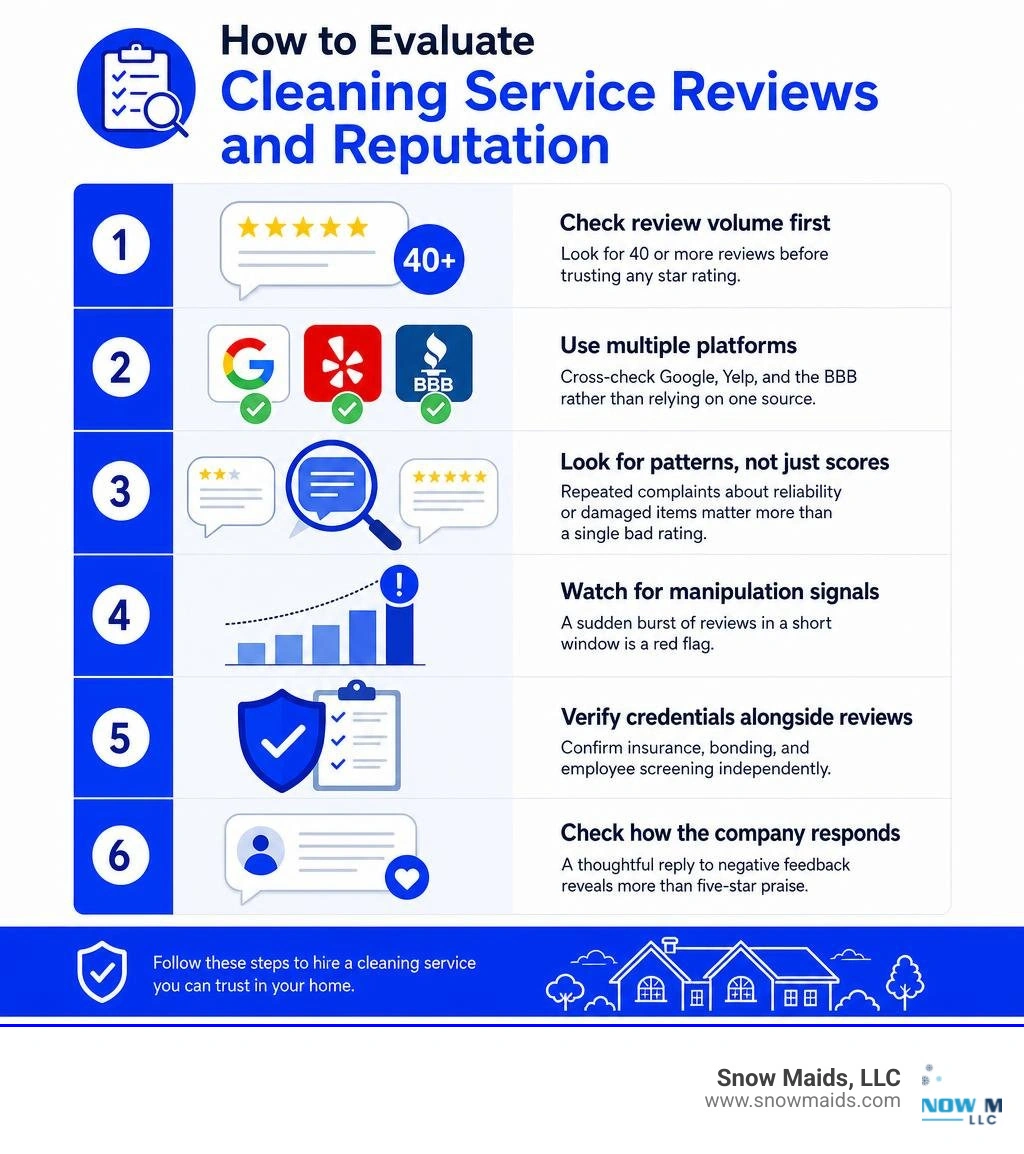
Step-by-step infographic showing how to evaluate cleaning service reviews and reputation infographic

How to evaluate cleaning service reviews and reputation vocab to learn:

Understanding Review Platforms and Verification Methods

Not all review platforms are created equal. When researching local cleaning companies in Littleton, Highlands Ranch, or Castle Rock, it is essential to understand how different sites gather and verify their data.

Review platforms generally fall into three main categories:

  • Open Submission Platforms (e.g., Google, Yelp): Anyone with an account can post a review. While these offer the largest volume of feedback, they are also the most susceptible to manipulation. Google relies on automated spam filters, while Yelp uses a notoriously strict recommendation algorithm that often hides legitimate reviews in an "unrecommended" folder.
  • Verified Purchase Platforms (e.g., Angi, Thumbtack): These sites attempt to connect reviews to actual transactions. However, because these platforms charge service providers lead fees, they have an inherent financial interest in keeping those providers active and looking successful.
  • Curated Vetting Platforms (e.g., Better Business Bureau): The BBB requires a formal process to file complaints and reviews, making it much harder to game. It is a fantastic tool for checking how a business handles disputes.

Reviewer demographics also play a massive role in how scores are distributed. For instance, Yelp users tend to write longer, more critical reviews, which can drag down a company's overall rating. Conversely, Google reviews are often shorter and lean more positive.

Understanding these platform-specific quirks is the first step toward learning How to Choose a Reliable House Cleaning Service. By looking at multiple sources, you can paint a realistic picture of a company's actual performance.

How to Evaluate Cleaning Service Reviews and Reputation

analyzing online reviews on a laptop

When you look at a cleaning company's online profile, your eyes probably dart straight to the star rating. But a 4.9-star rating can be highly misleading if you do not analyze the underlying data. To truly understand how to evaluate cleaning service reviews and reputation, you must look at three critical metrics: volume, distribution, and velocity.

First, consider review volume. In the home services industry, ratings with 40 or more reviews are considered statistically reliable. If a company has fewer than 25 reviews, their score should be treated as unverified, regardless of how close to a perfect 5.0 it is. A single bad day or two disgruntled customers could instantly drop an unverified 4.9 average down below a 4.5.

Second, look at score distribution. In a healthy, organic business, you will rarely see a perfect 5.0 across hundreds of reviews. Instead, you should see a natural "J-curve" or a slight distribution of four-star and occasional three-star reviews. These middle-of-the-road reviews often contain the most honest feedback about minor issues, like a missed spot on a baseboard or a slight scheduling delay.

Third, pay attention to review velocity—the rate at which a company accumulates reviews. Legitimate organic growth typically produces 2 to 8 new reviews per month for a single-location operator. If you notice a pattern where a company receives 3 reviews over 4 years followed by a sudden burst of 47 reviews in a 6-week window, you are likely looking at review manipulation or a paid campaign.

When you learn How to Decide Which Cleaning Service Is Right for Your Home, you learn to look past the surface-level star count and focus on these deeper analytical patterns.

Why You Must Know How to Evaluate Cleaning Service Reviews and Reputation to Spot Fake Feedback

The temptation for businesses to buy or manipulate reviews is high, which is why the Federal Trade Commission (FTC) finalized a strict rule prohibiting the buying and selling of fake consumer reviews, with penalties reaching up to $51,744 per violation. Despite this, fake feedback still slips through the cracks.

To protect your home and your wallet, watch for these common manipulation red flags:

  • Sudden Review Velocity Spikes: As mentioned, a massive influx of glowing reviews over a few days or weeks is highly suspicious.
  • Generic, Repetitive Language: Fake reviews often use vague phrasing like "Great service, very professional!" without mentioning specific details like the name of the cleaner, the rooms cleaned, or the specific town (such as Parker or Centennial).
  • Unverified or Empty Accounts: Click on the profiles of reviewers. If they have only ever left one review, or if they have left identical five-star reviews for businesses in different states on the same day, those accounts are likely fake.
  • Overly Defensive Tone: If a company responds to every piece of constructive feedback by accusing the reviewer of being a competitor or a liar, it suggests they are actively trying to hide operational flaws.

Step-by-Step: How to Evaluate Cleaning Service Reviews and Reputation Across Multiple Platforms

To get an accurate, unbiased look at a cleaning provider's reputation in Englewood, Lone Tree, or Littleton, follow this cross-referencing process:

  1. Compare Google and Yelp: If a company boasts a 4.9 on Google but sits at a 2.8 on Yelp, it is a sign that one of those datasets is distorted. Yelp's strict filter may be hiding real reviews, or the Google profile may be inflated by unverified feedback.
  2. Look for Specific Names: High-quality, organic reviews will often mention specific staff members by name. This shows that the company has consistent, long-term employees who build relationships with their clients.
  3. Perform a Sentiment Search: Use the search function on review pages to look for keywords like "theft," "damage," "late," "missed," or "communication." This helps you bypass the generic praise and get straight to the operational risks.
  4. Analyze the Recency: A company that was excellent in 2024 might have gone through a management change, leading to a sudden spike in negative reviews in 2026. Always sort by "Most Recent" to see how they are performing right now.

Assessing Operational Practices and Customer Service Quality

A company's reputation is not just built on what happens when things go right; it is defined by what happens when things go wrong. How a cleaning company handles mistakes is the ultimate test of their customer service quality.

Look closely at how the business responds to its negative feedback. Do they offer defensive excuses, or do they respond politely, take ownership of the mistake, and offer a clear path to resolution? A company that actively resolves complaints is far more reliable than one that ignores them.

You should also verify if the provider offers a clear, written satisfaction guarantee. A legitimate guarantee should outline exactly how you can report an issue (usually within 24 to 48 hours) and how quickly they will send a team back to reclean the area. Knowing What a Satisfaction Guarantee Means for Your Cleaning Experience gives you peace of mind, knowing that you will not be left paying for a substandard job.

Finally, consider starting with a trial clean. Booking a one-time standard clean before committing to a recurring weekly or biweekly contract allows you to evaluate their communication, punctuality, and attention to detail firsthand.

While online reviews are incredibly helpful, they only tell half the story. To truly protect your home, family, and assets in the Denver Metro Area, you must verify a company's legal credentials. Handing over your house key is a profound act of trust, and relying solely on star ratings is a risk you do not have to take.

First, check for General Liability Insurance. Any professional cleaning service operating in Colorado should carry a general liability policy with a limit of at least $1 million per occurrence. This insurance covers major accidental property damage—such as a chemical spill that ruins expensive hardwood floors or a broken plumbing fixture that causes a leak. Always ask the company to email you a Certificate of Insurance (COI) directly from their provider to verify that the policy is active.

Second, understand the role of Janitorial Surety Bonds. While liability insurance covers accidental damage, a surety bond protects you against intentional acts, such as employee theft. If an unbonded independent cleaner takes something from your home, your options are limited to filing a police report. A bonded company, however, provides a clear avenue for financial compensation.

Third, verify Workers' Compensation Insurance. This is a non-negotiable protection. If a cleaner slips on a wet tile floor in your kitchen and gets injured, and the company does not carry workers' compensation, you as the homeowner could be held legally and financially liable for their medical bills.

When you learn How Bonded and Insured Cleaning Protects Your Home, you protect yourself from catastrophic financial liabilities.

W-2 Employees vs. 1099 Independent Contractors

The staffing model a cleaning company uses has a massive impact on their legal liability, training consistency, and overall quality of service. Labor costs typically account for 50% to 70% of a total cleaning job cost. To save money, some companies hire 1099 independent contractors instead of W-2 employees.

Here is how these two models compare:

FeatureW-2 Employee Model1099 Contractor Model
Company Control & TrainingHigh. The company can legally mandate specific cleaning protocols, supply usage, and safety standards.Low. Legally, the company cannot dictate exactly how the contractor performs the job without risking misclassification.
Background ChecksRigorous. Covered by the company's strict vetting and hiring processes.Variable. Often self-reported or not consistently updated.
Liability & Insurance CoverageDirect. Employees are fully covered under the company's general liability and workers' comp policies.Complex. Contractors often must carry their own insurance, which is rarely verified by the booking agency.
ConsistencyHigh. You are much more likely to get the same trained cleaner or team on a recurring basis.Low. Jobs are often broadcasted to a network of independent workers, leading to high turnover.

Cross-Referencing Reviews with Official Records and BBB Complaints

To ensure the cleaning service you are considering is a legitimate, law-abiding business, take a few minutes to cross-reference their online presence with official databases:

  • Check the Colorado Secretary of State Database: Search the business name online to verify that they are registered, active, and in "Good Standing." A business that cannot supply an Entity ID or is listed as delinquent is a major red flag.
  • Search BBB Complaint Records: Go to the Better Business Bureau website and look up the company. Do not just look at the letter grade (A+ through F); look at the volume of closed complaints over the last 12 and 36 months. Pay attention to how those complaints were resolved. Unresolved complaints are a hard disqualifier.
  • Search for Legal Red Flags: Run a quick search of the company's name alongside terms like "lawsuit," "theft," or "scam" to see if any local news stories or court filings appear.

Taking these steps to ensure you are working with How Background-Checked and Bonded Local Cleaners Protect Your Home keeps your property safe and secure.

Frequently Asked Questions about Evaluating Cleaning Services

How many reviews are needed to trust a cleaning company's rating?

For statistical reliability in the home services industry, a company should have at least 40 verified reviews across platforms like Google and Yelp. Any average rating based on fewer than 25 reviews is considered statistically insufficient, as a couple of negative reviews can drastically alter the overall score.

What is the difference between being bonded and being insured?

General liability insurance covers accidental damage to your home or property (like a scratch on a marble countertop). A janitorial surety bond protects you against intentional misconduct or theft by an employee. A professional service should always carry both.

How do W-2 employees differ from independent contractors in cleaning quality?

W-2 employees are hired, trained, and directly supervised by the company, ensuring consistent cleaning standards and direct accountability. 1099 independent contractors operate as their own businesses, meaning the booking company has very little legal control over their training, techniques, or scheduling consistency.

Conclusion

Finding a reliable cleaning partner does not have to be a guessing game. By looking beyond the surface-level star ratings and analyzing review volume, distribution, and velocity, you can easily filter out manipulated feedback. Pairing this review analysis with hard credential verification—such as checking for W-2 staffing, $1 million in general liability insurance, bonding, and active business registration—ensures your home remains a safe, clean sanctuary.

Choosing a local provider also comes with unique perks. When you learn How Supporting Local Businesses Benefits Your Community, you see that local, family-owned companies are deeply invested in their neighborhood reputation and provide a level of personal care that national franchises simply cannot match.

At Snow Maids, LLC, we are proud to serve our neighbors across Castle Rock, Highlands Ranch, Parker, Centennial, and the entire Denver Metro Area. We use a dedicated team of fully vetted, insured, and bonded W-2 employees to deliver the reliable, "squeaky cleanings" you deserve.

Ready to reclaim your free time and experience a truly professional clean? Book Your Squeaky Clean Service Today and let us take care of the rest!

Why Knowing How to Evaluate Cleaning Service Reviews and Reputation Can Save You From a Bad Hire

Knowing how to evaluate cleaning service reviews and reputation is one of the most important steps you can take before letting anyone into your home. Most people spend more time picking a restaurant than vetting a cleaning company — and then feel surprised when the crew shows up unprepared or the results fall short.

Here is a quick-reference guide to get you started:

  1. Check review volume first — Look for 40 or more reviews before trusting any star rating
  2. Use multiple platforms — Cross-check Google, Yelp, and the BBB rather than relying on one source
  3. Look for patterns, not just scores — Repeated complaints about reliability or damaged items matter more than a single bad rating
  4. Watch for manipulation signals — A sudden burst of reviews in a short window is a red flag
  5. Verify credentials alongside reviews — Confirm insurance, bonding, and employee screening independently
  6. Check how the company responds — A thoughtful reply to negative feedback reveals more than five-star praise

For busy families and professionals in the Denver Metro Area, finding a trustworthy cleaning service means more than scanning star ratings. A company with a 4.9 average from only 11 reviews is statistically unreliable — just two negative reviews could push that score well below 4.5. Real reputation is built on volume, consistency, and verified credentials, not a handful of glowing comments.

This guide walks you through every layer of the evaluation process so you can hire with confidence.

Step-by-step infographic showing how to evaluate cleaning service reviews and reputation infographic

How to evaluate cleaning service reviews and reputation vocab to learn:

Understanding Review Platforms and Verification Methods

Not all review platforms are created equal. When researching local cleaning companies in Littleton, Highlands Ranch, or Castle Rock, it is essential to understand how different sites gather and verify their data.

Review platforms generally fall into three main categories:

  • Open Submission Platforms (e.g., Google, Yelp): Anyone with an account can post a review. While these offer the largest volume of feedback, they are also the most susceptible to manipulation. Google relies on automated spam filters, while Yelp uses a notoriously strict recommendation algorithm that often hides legitimate reviews in an "unrecommended" folder.
  • Verified Purchase Platforms (e.g., Angi, Thumbtack): These sites attempt to connect reviews to actual transactions. However, because these platforms charge service providers lead fees, they have an inherent financial interest in keeping those providers active and looking successful.
  • Curated Vetting Platforms (e.g., Better Business Bureau): The BBB requires a formal process to file complaints and reviews, making it much harder to game. It is a fantastic tool for checking how a business handles disputes.

Reviewer demographics also play a massive role in how scores are distributed. For instance, Yelp users tend to write longer, more critical reviews, which can drag down a company's overall rating. Conversely, Google reviews are often shorter and lean more positive.

Understanding these platform-specific quirks is the first step toward learning How to Choose a Reliable House Cleaning Service. By looking at multiple sources, you can paint a realistic picture of a company's actual performance.

How to Evaluate Cleaning Service Reviews and Reputation

analyzing online reviews on a laptop

When you look at a cleaning company's online profile, your eyes probably dart straight to the star rating. But a 4.9-star rating can be highly misleading if you do not analyze the underlying data. To truly understand how to evaluate cleaning service reviews and reputation, you must look at three critical metrics: volume, distribution, and velocity.

First, consider review volume. In the home services industry, ratings with 40 or more reviews are considered statistically reliable. If a company has fewer than 25 reviews, their score should be treated as unverified, regardless of how close to a perfect 5.0 it is. A single bad day or two disgruntled customers could instantly drop an unverified 4.9 average down below a 4.5.

Second, look at score distribution. In a healthy, organic business, you will rarely see a perfect 5.0 across hundreds of reviews. Instead, you should see a natural "J-curve" or a slight distribution of four-star and occasional three-star reviews. These middle-of-the-road reviews often contain the most honest feedback about minor issues, like a missed spot on a baseboard or a slight scheduling delay.

Third, pay attention to review velocity—the rate at which a company accumulates reviews. Legitimate organic growth typically produces 2 to 8 new reviews per month for a single-location operator. If you notice a pattern where a company receives 3 reviews over 4 years followed by a sudden burst of 47 reviews in a 6-week window, you are likely looking at review manipulation or a paid campaign.

When you learn How to Decide Which Cleaning Service Is Right for Your Home, you learn to look past the surface-level star count and focus on these deeper analytical patterns.

Why You Must Know How to Evaluate Cleaning Service Reviews and Reputation to Spot Fake Feedback

The temptation for businesses to buy or manipulate reviews is high, which is why the Federal Trade Commission (FTC) finalized a strict rule prohibiting the buying and selling of fake consumer reviews, with penalties reaching up to $51,744 per violation. Despite this, fake feedback still slips through the cracks.

To protect your home and your wallet, watch for these common manipulation red flags:

  • Sudden Review Velocity Spikes: As mentioned, a massive influx of glowing reviews over a few days or weeks is highly suspicious.
  • Generic, Repetitive Language: Fake reviews often use vague phrasing like "Great service, very professional!" without mentioning specific details like the name of the cleaner, the rooms cleaned, or the specific town (such as Parker or Centennial).
  • Unverified or Empty Accounts: Click on the profiles of reviewers. If they have only ever left one review, or if they have left identical five-star reviews for businesses in different states on the same day, those accounts are likely fake.
  • Overly Defensive Tone: If a company responds to every piece of constructive feedback by accusing the reviewer of being a competitor or a liar, it suggests they are actively trying to hide operational flaws.

Step-by-Step: How to Evaluate Cleaning Service Reviews and Reputation Across Multiple Platforms

To get an accurate, unbiased look at a cleaning provider's reputation in Englewood, Lone Tree, or Littleton, follow this cross-referencing process:

  1. Compare Google and Yelp: If a company boasts a 4.9 on Google but sits at a 2.8 on Yelp, it is a sign that one of those datasets is distorted. Yelp's strict filter may be hiding real reviews, or the Google profile may be inflated by unverified feedback.
  2. Look for Specific Names: High-quality, organic reviews will often mention specific staff members by name. This shows that the company has consistent, long-term employees who build relationships with their clients.
  3. Perform a Sentiment Search: Use the search function on review pages to look for keywords like "theft," "damage," "late," "missed," or "communication." This helps you bypass the generic praise and get straight to the operational risks.
  4. Analyze the Recency: A company that was excellent in 2024 might have gone through a management change, leading to a sudden spike in negative reviews in 2026. Always sort by "Most Recent" to see how they are performing right now.

Assessing Operational Practices and Customer Service Quality

A company's reputation is not just built on what happens when things go right; it is defined by what happens when things go wrong. How a cleaning company handles mistakes is the ultimate test of their customer service quality.

Look closely at how the business responds to its negative feedback. Do they offer defensive excuses, or do they respond politely, take ownership of the mistake, and offer a clear path to resolution? A company that actively resolves complaints is far more reliable than one that ignores them.

You should also verify if the provider offers a clear, written satisfaction guarantee. A legitimate guarantee should outline exactly how you can report an issue (usually within 24 to 48 hours) and how quickly they will send a team back to reclean the area. Knowing What a Satisfaction Guarantee Means for Your Cleaning Experience gives you peace of mind, knowing that you will not be left paying for a substandard job.

Finally, consider starting with a trial clean. Booking a one-time standard clean before committing to a recurring weekly or biweekly contract allows you to evaluate their communication, punctuality, and attention to detail firsthand.

While online reviews are incredibly helpful, they only tell half the story. To truly protect your home, family, and assets in the Denver Metro Area, you must verify a company's legal credentials. Handing over your house key is a profound act of trust, and relying solely on star ratings is a risk you do not have to take.

First, check for General Liability Insurance. Any professional cleaning service operating in Colorado should carry a general liability policy with a limit of at least $1 million per occurrence. This insurance covers major accidental property damage—such as a chemical spill that ruins expensive hardwood floors or a broken plumbing fixture that causes a leak. Always ask the company to email you a Certificate of Insurance (COI) directly from their provider to verify that the policy is active.

Second, understand the role of Janitorial Surety Bonds. While liability insurance covers accidental damage, a surety bond protects you against intentional acts, such as employee theft. If an unbonded independent cleaner takes something from your home, your options are limited to filing a police report. A bonded company, however, provides a clear avenue for financial compensation.

Third, verify Workers' Compensation Insurance. This is a non-negotiable protection. If a cleaner slips on a wet tile floor in your kitchen and gets injured, and the company does not carry workers' compensation, you as the homeowner could be held legally and financially liable for their medical bills.

When you learn How Bonded and Insured Cleaning Protects Your Home, you protect yourself from catastrophic financial liabilities.

W-2 Employees vs. 1099 Independent Contractors

The staffing model a cleaning company uses has a massive impact on their legal liability, training consistency, and overall quality of service. Labor costs typically account for 50% to 70% of a total cleaning job cost. To save money, some companies hire 1099 independent contractors instead of W-2 employees.

Here is how these two models compare:

FeatureW-2 Employee Model1099 Contractor Model
Company Control & TrainingHigh. The company can legally mandate specific cleaning protocols, supply usage, and safety standards.Low. Legally, the company cannot dictate exactly how the contractor performs the job without risking misclassification.
Background ChecksRigorous. Covered by the company's strict vetting and hiring processes.Variable. Often self-reported or not consistently updated.
Liability & Insurance CoverageDirect. Employees are fully covered under the company's general liability and workers' comp policies.Complex. Contractors often must carry their own insurance, which is rarely verified by the booking agency.
ConsistencyHigh. You are much more likely to get the same trained cleaner or team on a recurring basis.Low. Jobs are often broadcasted to a network of independent workers, leading to high turnover.

Cross-Referencing Reviews with Official Records and BBB Complaints

To ensure the cleaning service you are considering is a legitimate, law-abiding business, take a few minutes to cross-reference their online presence with official databases:

  • Check the Colorado Secretary of State Database: Search the business name online to verify that they are registered, active, and in "Good Standing." A business that cannot supply an Entity ID or is listed as delinquent is a major red flag.
  • Search BBB Complaint Records: Go to the Better Business Bureau website and look up the company. Do not just look at the letter grade (A+ through F); look at the volume of closed complaints over the last 12 and 36 months. Pay attention to how those complaints were resolved. Unresolved complaints are a hard disqualifier.
  • Search for Legal Red Flags: Run a quick search of the company's name alongside terms like "lawsuit," "theft," or "scam" to see if any local news stories or court filings appear.

Taking these steps to ensure you are working with How Background-Checked and Bonded Local Cleaners Protect Your Home keeps your property safe and secure.

Frequently Asked Questions about Evaluating Cleaning Services

How many reviews are needed to trust a cleaning company's rating?

For statistical reliability in the home services industry, a company should have at least 40 verified reviews across platforms like Google and Yelp. Any average rating based on fewer than 25 reviews is considered statistically insufficient, as a couple of negative reviews can drastically alter the overall score.

What is the difference between being bonded and being insured?

General liability insurance covers accidental damage to your home or property (like a scratch on a marble countertop). A janitorial surety bond protects you against intentional misconduct or theft by an employee. A professional service should always carry both.

How do W-2 employees differ from independent contractors in cleaning quality?

W-2 employees are hired, trained, and directly supervised by the company, ensuring consistent cleaning standards and direct accountability. 1099 independent contractors operate as their own businesses, meaning the booking company has very little legal control over their training, techniques, or scheduling consistency.

Conclusion

Finding a reliable cleaning partner does not have to be a guessing game. By looking beyond the surface-level star ratings and analyzing review volume, distribution, and velocity, you can easily filter out manipulated feedback. Pairing this review analysis with hard credential verification—such as checking for W-2 staffing, $1 million in general liability insurance, bonding, and active business registration—ensures your home remains a safe, clean sanctuary.

Choosing a local provider also comes with unique perks. When you learn How Supporting Local Businesses Benefits Your Community, you see that local, family-owned companies are deeply invested in their neighborhood reputation and provide a level of personal care that national franchises simply cannot match.

At Snow Maids, LLC, we are proud to serve our neighbors across Castle Rock, Highlands Ranch, Parker, Centennial, and the entire Denver Metro Area. We use a dedicated team of fully vetted, insured, and bonded W-2 employees to deliver the reliable, "squeaky cleanings" you deserve.

Ready to reclaim your free time and experience a truly professional clean? Book Your Squeaky Clean Service Today and let us take care of the rest!

Why Knowing How to Evaluate Cleaning Service Reviews and Reputation Can Save You From a Bad Hire

Knowing how to evaluate cleaning service reviews and reputation is one of the most important steps you can take before letting anyone into your home. Most people spend more time picking a restaurant than vetting a cleaning company — and then feel surprised when the crew shows up unprepared or the results fall short.

Here is a quick-reference guide to get you started:

  1. Check review volume first — Look for 40 or more reviews before trusting any star rating
  2. Use multiple platforms — Cross-check Google, Yelp, and the BBB rather than relying on one source
  3. Look for patterns, not just scores — Repeated complaints about reliability or damaged items matter more than a single bad rating
  4. Watch for manipulation signals — A sudden burst of reviews in a short window is a red flag
  5. Verify credentials alongside reviews — Confirm insurance, bonding, and employee screening independently
  6. Check how the company responds — A thoughtful reply to negative feedback reveals more than five-star praise

For busy families and professionals in the Denver Metro Area, finding a trustworthy cleaning service means more than scanning star ratings. A company with a 4.9 average from only 11 reviews is statistically unreliable — just two negative reviews could push that score well below 4.5. Real reputation is built on volume, consistency, and verified credentials, not a handful of glowing comments.

This guide walks you through every layer of the evaluation process so you can hire with confidence.

Step-by-step infographic showing how to evaluate cleaning service reviews and reputation infographic

How to evaluate cleaning service reviews and reputation vocab to learn:

Understanding Review Platforms and Verification Methods

Not all review platforms are created equal. When researching local cleaning companies in Littleton, Highlands Ranch, or Castle Rock, it is essential to understand how different sites gather and verify their data.

Review platforms generally fall into three main categories:

  • Open Submission Platforms (e.g., Google, Yelp): Anyone with an account can post a review. While these offer the largest volume of feedback, they are also the most susceptible to manipulation. Google relies on automated spam filters, while Yelp uses a notoriously strict recommendation algorithm that often hides legitimate reviews in an "unrecommended" folder.
  • Verified Purchase Platforms (e.g., Angi, Thumbtack): These sites attempt to connect reviews to actual transactions. However, because these platforms charge service providers lead fees, they have an inherent financial interest in keeping those providers active and looking successful.
  • Curated Vetting Platforms (e.g., Better Business Bureau): The BBB requires a formal process to file complaints and reviews, making it much harder to game. It is a fantastic tool for checking how a business handles disputes.

Reviewer demographics also play a massive role in how scores are distributed. For instance, Yelp users tend to write longer, more critical reviews, which can drag down a company's overall rating. Conversely, Google reviews are often shorter and lean more positive.

Understanding these platform-specific quirks is the first step toward learning How to Choose a Reliable House Cleaning Service. By looking at multiple sources, you can paint a realistic picture of a company's actual performance.

How to Evaluate Cleaning Service Reviews and Reputation

analyzing online reviews on a laptop

When you look at a cleaning company's online profile, your eyes probably dart straight to the star rating. But a 4.9-star rating can be highly misleading if you do not analyze the underlying data. To truly understand how to evaluate cleaning service reviews and reputation, you must look at three critical metrics: volume, distribution, and velocity.

First, consider review volume. In the home services industry, ratings with 40 or more reviews are considered statistically reliable. If a company has fewer than 25 reviews, their score should be treated as unverified, regardless of how close to a perfect 5.0 it is. A single bad day or two disgruntled customers could instantly drop an unverified 4.9 average down below a 4.5.

Second, look at score distribution. In a healthy, organic business, you will rarely see a perfect 5.0 across hundreds of reviews. Instead, you should see a natural "J-curve" or a slight distribution of four-star and occasional three-star reviews. These middle-of-the-road reviews often contain the most honest feedback about minor issues, like a missed spot on a baseboard or a slight scheduling delay.

Third, pay attention to review velocity—the rate at which a company accumulates reviews. Legitimate organic growth typically produces 2 to 8 new reviews per month for a single-location operator. If you notice a pattern where a company receives 3 reviews over 4 years followed by a sudden burst of 47 reviews in a 6-week window, you are likely looking at review manipulation or a paid campaign.

When you learn How to Decide Which Cleaning Service Is Right for Your Home, you learn to look past the surface-level star count and focus on these deeper analytical patterns.

Why You Must Know How to Evaluate Cleaning Service Reviews and Reputation to Spot Fake Feedback

The temptation for businesses to buy or manipulate reviews is high, which is why the Federal Trade Commission (FTC) finalized a strict rule prohibiting the buying and selling of fake consumer reviews, with penalties reaching up to $51,744 per violation. Despite this, fake feedback still slips through the cracks.

To protect your home and your wallet, watch for these common manipulation red flags:

  • Sudden Review Velocity Spikes: As mentioned, a massive influx of glowing reviews over a few days or weeks is highly suspicious.
  • Generic, Repetitive Language: Fake reviews often use vague phrasing like "Great service, very professional!" without mentioning specific details like the name of the cleaner, the rooms cleaned, or the specific town (such as Parker or Centennial).
  • Unverified or Empty Accounts: Click on the profiles of reviewers. If they have only ever left one review, or if they have left identical five-star reviews for businesses in different states on the same day, those accounts are likely fake.
  • Overly Defensive Tone: If a company responds to every piece of constructive feedback by accusing the reviewer of being a competitor or a liar, it suggests they are actively trying to hide operational flaws.

Step-by-Step: How to Evaluate Cleaning Service Reviews and Reputation Across Multiple Platforms

To get an accurate, unbiased look at a cleaning provider's reputation in Englewood, Lone Tree, or Littleton, follow this cross-referencing process:

  1. Compare Google and Yelp: If a company boasts a 4.9 on Google but sits at a 2.8 on Yelp, it is a sign that one of those datasets is distorted. Yelp's strict filter may be hiding real reviews, or the Google profile may be inflated by unverified feedback.
  2. Look for Specific Names: High-quality, organic reviews will often mention specific staff members by name. This shows that the company has consistent, long-term employees who build relationships with their clients.
  3. Perform a Sentiment Search: Use the search function on review pages to look for keywords like "theft," "damage," "late," "missed," or "communication." This helps you bypass the generic praise and get straight to the operational risks.
  4. Analyze the Recency: A company that was excellent in 2024 might have gone through a management change, leading to a sudden spike in negative reviews in 2026. Always sort by "Most Recent" to see how they are performing right now.

Assessing Operational Practices and Customer Service Quality

A company's reputation is not just built on what happens when things go right; it is defined by what happens when things go wrong. How a cleaning company handles mistakes is the ultimate test of their customer service quality.

Look closely at how the business responds to its negative feedback. Do they offer defensive excuses, or do they respond politely, take ownership of the mistake, and offer a clear path to resolution? A company that actively resolves complaints is far more reliable than one that ignores them.

You should also verify if the provider offers a clear, written satisfaction guarantee. A legitimate guarantee should outline exactly how you can report an issue (usually within 24 to 48 hours) and how quickly they will send a team back to reclean the area. Knowing What a Satisfaction Guarantee Means for Your Cleaning Experience gives you peace of mind, knowing that you will not be left paying for a substandard job.

Finally, consider starting with a trial clean. Booking a one-time standard clean before committing to a recurring weekly or biweekly contract allows you to evaluate their communication, punctuality, and attention to detail firsthand.

While online reviews are incredibly helpful, they only tell half the story. To truly protect your home, family, and assets in the Denver Metro Area, you must verify a company's legal credentials. Handing over your house key is a profound act of trust, and relying solely on star ratings is a risk you do not have to take.

First, check for General Liability Insurance. Any professional cleaning service operating in Colorado should carry a general liability policy with a limit of at least $1 million per occurrence. This insurance covers major accidental property damage—such as a chemical spill that ruins expensive hardwood floors or a broken plumbing fixture that causes a leak. Always ask the company to email you a Certificate of Insurance (COI) directly from their provider to verify that the policy is active.

Second, understand the role of Janitorial Surety Bonds. While liability insurance covers accidental damage, a surety bond protects you against intentional acts, such as employee theft. If an unbonded independent cleaner takes something from your home, your options are limited to filing a police report. A bonded company, however, provides a clear avenue for financial compensation.

Third, verify Workers' Compensation Insurance. This is a non-negotiable protection. If a cleaner slips on a wet tile floor in your kitchen and gets injured, and the company does not carry workers' compensation, you as the homeowner could be held legally and financially liable for their medical bills.

When you learn How Bonded and Insured Cleaning Protects Your Home, you protect yourself from catastrophic financial liabilities.

W-2 Employees vs. 1099 Independent Contractors

The staffing model a cleaning company uses has a massive impact on their legal liability, training consistency, and overall quality of service. Labor costs typically account for 50% to 70% of a total cleaning job cost. To save money, some companies hire 1099 independent contractors instead of W-2 employees.

Here is how these two models compare:

FeatureW-2 Employee Model1099 Contractor Model
Company Control & TrainingHigh. The company can legally mandate specific cleaning protocols, supply usage, and safety standards.Low. Legally, the company cannot dictate exactly how the contractor performs the job without risking misclassification.
Background ChecksRigorous. Covered by the company's strict vetting and hiring processes.Variable. Often self-reported or not consistently updated.
Liability & Insurance CoverageDirect. Employees are fully covered under the company's general liability and workers' comp policies.Complex. Contractors often must carry their own insurance, which is rarely verified by the booking agency.
ConsistencyHigh. You are much more likely to get the same trained cleaner or team on a recurring basis.Low. Jobs are often broadcasted to a network of independent workers, leading to high turnover.

Cross-Referencing Reviews with Official Records and BBB Complaints

To ensure the cleaning service you are considering is a legitimate, law-abiding business, take a few minutes to cross-reference their online presence with official databases:

  • Check the Colorado Secretary of State Database: Search the business name online to verify that they are registered, active, and in "Good Standing." A business that cannot supply an Entity ID or is listed as delinquent is a major red flag.
  • Search BBB Complaint Records: Go to the Better Business Bureau website and look up the company. Do not just look at the letter grade (A+ through F); look at the volume of closed complaints over the last 12 and 36 months. Pay attention to how those complaints were resolved. Unresolved complaints are a hard disqualifier.
  • Search for Legal Red Flags: Run a quick search of the company's name alongside terms like "lawsuit," "theft," or "scam" to see if any local news stories or court filings appear.

Taking these steps to ensure you are working with How Background-Checked and Bonded Local Cleaners Protect Your Home keeps your property safe and secure.

Frequently Asked Questions about Evaluating Cleaning Services

How many reviews are needed to trust a cleaning company's rating?

For statistical reliability in the home services industry, a company should have at least 40 verified reviews across platforms like Google and Yelp. Any average rating based on fewer than 25 reviews is considered statistically insufficient, as a couple of negative reviews can drastically alter the overall score.

What is the difference between being bonded and being insured?

General liability insurance covers accidental damage to your home or property (like a scratch on a marble countertop). A janitorial surety bond protects you against intentional misconduct or theft by an employee. A professional service should always carry both.

How do W-2 employees differ from independent contractors in cleaning quality?

W-2 employees are hired, trained, and directly supervised by the company, ensuring consistent cleaning standards and direct accountability. 1099 independent contractors operate as their own businesses, meaning the booking company has very little legal control over their training, techniques, or scheduling consistency.

Conclusion

Finding a reliable cleaning partner does not have to be a guessing game. By looking beyond the surface-level star ratings and analyzing review volume, distribution, and velocity, you can easily filter out manipulated feedback. Pairing this review analysis with hard credential verification—such as checking for W-2 staffing, $1 million in general liability insurance, bonding, and active business registration—ensures your home remains a safe, clean sanctuary.

Choosing a local provider also comes with unique perks. When you learn How Supporting Local Businesses Benefits Your Community, you see that local, family-owned companies are deeply invested in their neighborhood reputation and provide a level of personal care that national franchises simply cannot match.

At Snow Maids, LLC, we are proud to serve our neighbors across Castle Rock, Highlands Ranch, Parker, Centennial, and the entire Denver Metro Area. We use a dedicated team of fully vetted, insured, and bonded W-2 employees to deliver the reliable, "squeaky cleanings" you deserve.

Ready to reclaim your free time and experience a truly professional clean? Book Your Squeaky Clean Service Today and let us take care of the rest!

In Depth Guide to Evaluating Cleaning Service Reviews

Why Knowing How to Evaluate Cleaning Service Reviews and Reputation Can Save You From a Bad Hire

Knowing how to evaluate cleaning service reviews and reputation is one of the most important steps you can take before letting anyone into your home. Most people spend more time picking a restaurant than vetting a cleaning company — and then feel surprised when the crew shows up unprepared or the results fall short.

Here is a quick-reference guide to get you started:

  1. Check review volume first — Look for 40 or more reviews before trusting any star rating
  2. Use multiple platforms — Cross-check Google, Yelp, and the BBB rather than relying on one source
  3. Look for patterns, not just scores — Repeated complaints about reliability or damaged items matter more than a single bad rating
  4. Watch for manipulation signals — A sudden burst of reviews in a short window is a red flag
  5. Verify credentials alongside reviews — Confirm insurance, bonding, and employee screening independently
  6. Check how the company responds — A thoughtful reply to negative feedback reveals more than five-star praise

For busy families and professionals in the Denver Metro Area, finding a trustworthy cleaning service means more than scanning star ratings. A company with a 4.9 average from only 11 reviews is statistically unreliable — just two negative reviews could push that score well below 4.5. Real reputation is built on volume, consistency, and verified credentials, not a handful of glowing comments.

This guide walks you through every layer of the evaluation process so you can hire with confidence.

Step-by-step infographic showing how to evaluate cleaning service reviews and reputation infographic

How to evaluate cleaning service reviews and reputation vocab to learn:

Understanding Review Platforms and Verification Methods

Not all review platforms are created equal. When researching local cleaning companies in Littleton, Highlands Ranch, or Castle Rock, it is essential to understand how different sites gather and verify their data.

Review platforms generally fall into three main categories:

  • Open Submission Platforms (e.g., Google, Yelp): Anyone with an account can post a review. While these offer the largest volume of feedback, they are also the most susceptible to manipulation. Google relies on automated spam filters, while Yelp uses a notoriously strict recommendation algorithm that often hides legitimate reviews in an "unrecommended" folder.
  • Verified Purchase Platforms (e.g., Angi, Thumbtack): These sites attempt to connect reviews to actual transactions. However, because these platforms charge service providers lead fees, they have an inherent financial interest in keeping those providers active and looking successful.
  • Curated Vetting Platforms (e.g., Better Business Bureau): The BBB requires a formal process to file complaints and reviews, making it much harder to game. It is a fantastic tool for checking how a business handles disputes.

Reviewer demographics also play a massive role in how scores are distributed. For instance, Yelp users tend to write longer, more critical reviews, which can drag down a company's overall rating. Conversely, Google reviews are often shorter and lean more positive.

Understanding these platform-specific quirks is the first step toward learning How to Choose a Reliable House Cleaning Service. By looking at multiple sources, you can paint a realistic picture of a company's actual performance.

How to Evaluate Cleaning Service Reviews and Reputation

analyzing online reviews on a laptop

When you look at a cleaning company's online profile, your eyes probably dart straight to the star rating. But a 4.9-star rating can be highly misleading if you do not analyze the underlying data. To truly understand how to evaluate cleaning service reviews and reputation, you must look at three critical metrics: volume, distribution, and velocity.

First, consider review volume. In the home services industry, ratings with 40 or more reviews are considered statistically reliable. If a company has fewer than 25 reviews, their score should be treated as unverified, regardless of how close to a perfect 5.0 it is. A single bad day or two disgruntled customers could instantly drop an unverified 4.9 average down below a 4.5.

Second, look at score distribution. In a healthy, organic business, you will rarely see a perfect 5.0 across hundreds of reviews. Instead, you should see a natural "J-curve" or a slight distribution of four-star and occasional three-star reviews. These middle-of-the-road reviews often contain the most honest feedback about minor issues, like a missed spot on a baseboard or a slight scheduling delay.

Third, pay attention to review velocity—the rate at which a company accumulates reviews. Legitimate organic growth typically produces 2 to 8 new reviews per month for a single-location operator. If you notice a pattern where a company receives 3 reviews over 4 years followed by a sudden burst of 47 reviews in a 6-week window, you are likely looking at review manipulation or a paid campaign.

When you learn How to Decide Which Cleaning Service Is Right for Your Home, you learn to look past the surface-level star count and focus on these deeper analytical patterns.

Why You Must Know How to Evaluate Cleaning Service Reviews and Reputation to Spot Fake Feedback

The temptation for businesses to buy or manipulate reviews is high, which is why the Federal Trade Commission (FTC) finalized a strict rule prohibiting the buying and selling of fake consumer reviews, with penalties reaching up to $51,744 per violation. Despite this, fake feedback still slips through the cracks.

To protect your home and your wallet, watch for these common manipulation red flags:

  • Sudden Review Velocity Spikes: As mentioned, a massive influx of glowing reviews over a few days or weeks is highly suspicious.
  • Generic, Repetitive Language: Fake reviews often use vague phrasing like "Great service, very professional!" without mentioning specific details like the name of the cleaner, the rooms cleaned, or the specific town (such as Parker or Centennial).
  • Unverified or Empty Accounts: Click on the profiles of reviewers. If they have only ever left one review, or if they have left identical five-star reviews for businesses in different states on the same day, those accounts are likely fake.
  • Overly Defensive Tone: If a company responds to every piece of constructive feedback by accusing the reviewer of being a competitor or a liar, it suggests they are actively trying to hide operational flaws.

Step-by-Step: How to Evaluate Cleaning Service Reviews and Reputation Across Multiple Platforms

To get an accurate, unbiased look at a cleaning provider's reputation in Englewood, Lone Tree, or Littleton, follow this cross-referencing process:

  1. Compare Google and Yelp: If a company boasts a 4.9 on Google but sits at a 2.8 on Yelp, it is a sign that one of those datasets is distorted. Yelp's strict filter may be hiding real reviews, or the Google profile may be inflated by unverified feedback.
  2. Look for Specific Names: High-quality, organic reviews will often mention specific staff members by name. This shows that the company has consistent, long-term employees who build relationships with their clients.
  3. Perform a Sentiment Search: Use the search function on review pages to look for keywords like "theft," "damage," "late," "missed," or "communication." This helps you bypass the generic praise and get straight to the operational risks.
  4. Analyze the Recency: A company that was excellent in 2024 might have gone through a management change, leading to a sudden spike in negative reviews in 2026. Always sort by "Most Recent" to see how they are performing right now.

Assessing Operational Practices and Customer Service Quality

A company's reputation is not just built on what happens when things go right; it is defined by what happens when things go wrong. How a cleaning company handles mistakes is the ultimate test of their customer service quality.

Look closely at how the business responds to its negative feedback. Do they offer defensive excuses, or do they respond politely, take ownership of the mistake, and offer a clear path to resolution? A company that actively resolves complaints is far more reliable than one that ignores them.

You should also verify if the provider offers a clear, written satisfaction guarantee. A legitimate guarantee should outline exactly how you can report an issue (usually within 24 to 48 hours) and how quickly they will send a team back to reclean the area. Knowing What a Satisfaction Guarantee Means for Your Cleaning Experience gives you peace of mind, knowing that you will not be left paying for a substandard job.

Finally, consider starting with a trial clean. Booking a one-time standard clean before committing to a recurring weekly or biweekly contract allows you to evaluate their communication, punctuality, and attention to detail firsthand.

While online reviews are incredibly helpful, they only tell half the story. To truly protect your home, family, and assets in the Denver Metro Area, you must verify a company's legal credentials. Handing over your house key is a profound act of trust, and relying solely on star ratings is a risk you do not have to take.

First, check for General Liability Insurance. Any professional cleaning service operating in Colorado should carry a general liability policy with a limit of at least $1 million per occurrence. This insurance covers major accidental property damage—such as a chemical spill that ruins expensive hardwood floors or a broken plumbing fixture that causes a leak. Always ask the company to email you a Certificate of Insurance (COI) directly from their provider to verify that the policy is active.

Second, understand the role of Janitorial Surety Bonds. While liability insurance covers accidental damage, a surety bond protects you against intentional acts, such as employee theft. If an unbonded independent cleaner takes something from your home, your options are limited to filing a police report. A bonded company, however, provides a clear avenue for financial compensation.

Third, verify Workers' Compensation Insurance. This is a non-negotiable protection. If a cleaner slips on a wet tile floor in your kitchen and gets injured, and the company does not carry workers' compensation, you as the homeowner could be held legally and financially liable for their medical bills.

When you learn How Bonded and Insured Cleaning Protects Your Home, you protect yourself from catastrophic financial liabilities.

W-2 Employees vs. 1099 Independent Contractors

The staffing model a cleaning company uses has a massive impact on their legal liability, training consistency, and overall quality of service. Labor costs typically account for 50% to 70% of a total cleaning job cost. To save money, some companies hire 1099 independent contractors instead of W-2 employees.

Here is how these two models compare:

FeatureW-2 Employee Model1099 Contractor Model
Company Control & TrainingHigh. The company can legally mandate specific cleaning protocols, supply usage, and safety standards.Low. Legally, the company cannot dictate exactly how the contractor performs the job without risking misclassification.
Background ChecksRigorous. Covered by the company's strict vetting and hiring processes.Variable. Often self-reported or not consistently updated.
Liability & Insurance CoverageDirect. Employees are fully covered under the company's general liability and workers' comp policies.Complex. Contractors often must carry their own insurance, which is rarely verified by the booking agency.
ConsistencyHigh. You are much more likely to get the same trained cleaner or team on a recurring basis.Low. Jobs are often broadcasted to a network of independent workers, leading to high turnover.

Cross-Referencing Reviews with Official Records and BBB Complaints

To ensure the cleaning service you are considering is a legitimate, law-abiding business, take a few minutes to cross-reference their online presence with official databases:

  • Check the Colorado Secretary of State Database: Search the business name online to verify that they are registered, active, and in "Good Standing." A business that cannot supply an Entity ID or is listed as delinquent is a major red flag.
  • Search BBB Complaint Records: Go to the Better Business Bureau website and look up the company. Do not just look at the letter grade (A+ through F); look at the volume of closed complaints over the last 12 and 36 months. Pay attention to how those complaints were resolved. Unresolved complaints are a hard disqualifier.
  • Search for Legal Red Flags: Run a quick search of the company's name alongside terms like "lawsuit," "theft," or "scam" to see if any local news stories or court filings appear.

Taking these steps to ensure you are working with How Background-Checked and Bonded Local Cleaners Protect Your Home keeps your property safe and secure.

Frequently Asked Questions about Evaluating Cleaning Services

How many reviews are needed to trust a cleaning company's rating?

For statistical reliability in the home services industry, a company should have at least 40 verified reviews across platforms like Google and Yelp. Any average rating based on fewer than 25 reviews is considered statistically insufficient, as a couple of negative reviews can drastically alter the overall score.

What is the difference between being bonded and being insured?

General liability insurance covers accidental damage to your home or property (like a scratch on a marble countertop). A janitorial surety bond protects you against intentional misconduct or theft by an employee. A professional service should always carry both.

How do W-2 employees differ from independent contractors in cleaning quality?

W-2 employees are hired, trained, and directly supervised by the company, ensuring consistent cleaning standards and direct accountability. 1099 independent contractors operate as their own businesses, meaning the booking company has very little legal control over their training, techniques, or scheduling consistency.

Conclusion

Finding a reliable cleaning partner does not have to be a guessing game. By looking beyond the surface-level star ratings and analyzing review volume, distribution, and velocity, you can easily filter out manipulated feedback. Pairing this review analysis with hard credential verification—such as checking for W-2 staffing, $1 million in general liability insurance, bonding, and active business registration—ensures your home remains a safe, clean sanctuary.

Choosing a local provider also comes with unique perks. When you learn How Supporting Local Businesses Benefits Your Community, you see that local, family-owned companies are deeply invested in their neighborhood reputation and provide a level of personal care that national franchises simply cannot match.

At Snow Maids, LLC, we are proud to serve our neighbors across Castle Rock, Highlands Ranch, Parker, Centennial, and the entire Denver Metro Area. We use a dedicated team of fully vetted, insured, and bonded W-2 employees to deliver the reliable, "squeaky cleanings" you deserve.

Ready to reclaim your free time and experience a truly professional clean? Book Your Squeaky Clean Service Today and let us take care of the rest!

Why Knowing How to Evaluate Cleaning Service Reviews and Reputation Can Save You From a Bad Hire

Knowing how to evaluate cleaning service reviews and reputation is one of the most important steps you can take before letting anyone into your home. Most people spend more time picking a restaurant than vetting a cleaning company — and then feel surprised when the crew shows up unprepared or the results fall short.

Here is a quick-reference guide to get you started:

  1. Check review volume first — Look for 40 or more reviews before trusting any star rating
  2. Use multiple platforms — Cross-check Google, Yelp, and the BBB rather than relying on one source
  3. Look for patterns, not just scores — Repeated complaints about reliability or damaged items matter more than a single bad rating
  4. Watch for manipulation signals — A sudden burst of reviews in a short window is a red flag
  5. Verify credentials alongside reviews — Confirm insurance, bonding, and employee screening independently
  6. Check how the company responds — A thoughtful reply to negative feedback reveals more than five-star praise

For busy families and professionals in the Denver Metro Area, finding a trustworthy cleaning service means more than scanning star ratings. A company with a 4.9 average from only 11 reviews is statistically unreliable — just two negative reviews could push that score well below 4.5. Real reputation is built on volume, consistency, and verified credentials, not a handful of glowing comments.

This guide walks you through every layer of the evaluation process so you can hire with confidence.

Step-by-step infographic showing how to evaluate cleaning service reviews and reputation infographic

How to evaluate cleaning service reviews and reputation vocab to learn:

Understanding Review Platforms and Verification Methods

Not all review platforms are created equal. When researching local cleaning companies in Littleton, Highlands Ranch, or Castle Rock, it is essential to understand how different sites gather and verify their data.

Review platforms generally fall into three main categories:

  • Open Submission Platforms (e.g., Google, Yelp): Anyone with an account can post a review. While these offer the largest volume of feedback, they are also the most susceptible to manipulation. Google relies on automated spam filters, while Yelp uses a notoriously strict recommendation algorithm that often hides legitimate reviews in an "unrecommended" folder.
  • Verified Purchase Platforms (e.g., Angi, Thumbtack): These sites attempt to connect reviews to actual transactions. However, because these platforms charge service providers lead fees, they have an inherent financial interest in keeping those providers active and looking successful.
  • Curated Vetting Platforms (e.g., Better Business Bureau): The BBB requires a formal process to file complaints and reviews, making it much harder to game. It is a fantastic tool for checking how a business handles disputes.

Reviewer demographics also play a massive role in how scores are distributed. For instance, Yelp users tend to write longer, more critical reviews, which can drag down a company's overall rating. Conversely, Google reviews are often shorter and lean more positive.

Understanding these platform-specific quirks is the first step toward learning How to Choose a Reliable House Cleaning Service. By looking at multiple sources, you can paint a realistic picture of a company's actual performance.

How to Evaluate Cleaning Service Reviews and Reputation

analyzing online reviews on a laptop

When you look at a cleaning company's online profile, your eyes probably dart straight to the star rating. But a 4.9-star rating can be highly misleading if you do not analyze the underlying data. To truly understand how to evaluate cleaning service reviews and reputation, you must look at three critical metrics: volume, distribution, and velocity.

First, consider review volume. In the home services industry, ratings with 40 or more reviews are considered statistically reliable. If a company has fewer than 25 reviews, their score should be treated as unverified, regardless of how close to a perfect 5.0 it is. A single bad day or two disgruntled customers could instantly drop an unverified 4.9 average down below a 4.5.

Second, look at score distribution. In a healthy, organic business, you will rarely see a perfect 5.0 across hundreds of reviews. Instead, you should see a natural "J-curve" or a slight distribution of four-star and occasional three-star reviews. These middle-of-the-road reviews often contain the most honest feedback about minor issues, like a missed spot on a baseboard or a slight scheduling delay.

Third, pay attention to review velocity—the rate at which a company accumulates reviews. Legitimate organic growth typically produces 2 to 8 new reviews per month for a single-location operator. If you notice a pattern where a company receives 3 reviews over 4 years followed by a sudden burst of 47 reviews in a 6-week window, you are likely looking at review manipulation or a paid campaign.

When you learn How to Decide Which Cleaning Service Is Right for Your Home, you learn to look past the surface-level star count and focus on these deeper analytical patterns.

Why You Must Know How to Evaluate Cleaning Service Reviews and Reputation to Spot Fake Feedback

The temptation for businesses to buy or manipulate reviews is high, which is why the Federal Trade Commission (FTC) finalized a strict rule prohibiting the buying and selling of fake consumer reviews, with penalties reaching up to $51,744 per violation. Despite this, fake feedback still slips through the cracks.

To protect your home and your wallet, watch for these common manipulation red flags:

  • Sudden Review Velocity Spikes: As mentioned, a massive influx of glowing reviews over a few days or weeks is highly suspicious.
  • Generic, Repetitive Language: Fake reviews often use vague phrasing like "Great service, very professional!" without mentioning specific details like the name of the cleaner, the rooms cleaned, or the specific town (such as Parker or Centennial).
  • Unverified or Empty Accounts: Click on the profiles of reviewers. If they have only ever left one review, or if they have left identical five-star reviews for businesses in different states on the same day, those accounts are likely fake.
  • Overly Defensive Tone: If a company responds to every piece of constructive feedback by accusing the reviewer of being a competitor or a liar, it suggests they are actively trying to hide operational flaws.

Step-by-Step: How to Evaluate Cleaning Service Reviews and Reputation Across Multiple Platforms

To get an accurate, unbiased look at a cleaning provider's reputation in Englewood, Lone Tree, or Littleton, follow this cross-referencing process:

  1. Compare Google and Yelp: If a company boasts a 4.9 on Google but sits at a 2.8 on Yelp, it is a sign that one of those datasets is distorted. Yelp's strict filter may be hiding real reviews, or the Google profile may be inflated by unverified feedback.
  2. Look for Specific Names: High-quality, organic reviews will often mention specific staff members by name. This shows that the company has consistent, long-term employees who build relationships with their clients.
  3. Perform a Sentiment Search: Use the search function on review pages to look for keywords like "theft," "damage," "late," "missed," or "communication." This helps you bypass the generic praise and get straight to the operational risks.
  4. Analyze the Recency: A company that was excellent in 2024 might have gone through a management change, leading to a sudden spike in negative reviews in 2026. Always sort by "Most Recent" to see how they are performing right now.

Assessing Operational Practices and Customer Service Quality

A company's reputation is not just built on what happens when things go right; it is defined by what happens when things go wrong. How a cleaning company handles mistakes is the ultimate test of their customer service quality.

Look closely at how the business responds to its negative feedback. Do they offer defensive excuses, or do they respond politely, take ownership of the mistake, and offer a clear path to resolution? A company that actively resolves complaints is far more reliable than one that ignores them.

You should also verify if the provider offers a clear, written satisfaction guarantee. A legitimate guarantee should outline exactly how you can report an issue (usually within 24 to 48 hours) and how quickly they will send a team back to reclean the area. Knowing What a Satisfaction Guarantee Means for Your Cleaning Experience gives you peace of mind, knowing that you will not be left paying for a substandard job.

Finally, consider starting with a trial clean. Booking a one-time standard clean before committing to a recurring weekly or biweekly contract allows you to evaluate their communication, punctuality, and attention to detail firsthand.

While online reviews are incredibly helpful, they only tell half the story. To truly protect your home, family, and assets in the Denver Metro Area, you must verify a company's legal credentials. Handing over your house key is a profound act of trust, and relying solely on star ratings is a risk you do not have to take.

First, check for General Liability Insurance. Any professional cleaning service operating in Colorado should carry a general liability policy with a limit of at least $1 million per occurrence. This insurance covers major accidental property damage—such as a chemical spill that ruins expensive hardwood floors or a broken plumbing fixture that causes a leak. Always ask the company to email you a Certificate of Insurance (COI) directly from their provider to verify that the policy is active.

Second, understand the role of Janitorial Surety Bonds. While liability insurance covers accidental damage, a surety bond protects you against intentional acts, such as employee theft. If an unbonded independent cleaner takes something from your home, your options are limited to filing a police report. A bonded company, however, provides a clear avenue for financial compensation.

Third, verify Workers' Compensation Insurance. This is a non-negotiable protection. If a cleaner slips on a wet tile floor in your kitchen and gets injured, and the company does not carry workers' compensation, you as the homeowner could be held legally and financially liable for their medical bills.

When you learn How Bonded and Insured Cleaning Protects Your Home, you protect yourself from catastrophic financial liabilities.

W-2 Employees vs. 1099 Independent Contractors

The staffing model a cleaning company uses has a massive impact on their legal liability, training consistency, and overall quality of service. Labor costs typically account for 50% to 70% of a total cleaning job cost. To save money, some companies hire 1099 independent contractors instead of W-2 employees.

Here is how these two models compare:

FeatureW-2 Employee Model1099 Contractor Model
Company Control & TrainingHigh. The company can legally mandate specific cleaning protocols, supply usage, and safety standards.Low. Legally, the company cannot dictate exactly how the contractor performs the job without risking misclassification.
Background ChecksRigorous. Covered by the company's strict vetting and hiring processes.Variable. Often self-reported or not consistently updated.
Liability & Insurance CoverageDirect. Employees are fully covered under the company's general liability and workers' comp policies.Complex. Contractors often must carry their own insurance, which is rarely verified by the booking agency.
ConsistencyHigh. You are much more likely to get the same trained cleaner or team on a recurring basis.Low. Jobs are often broadcasted to a network of independent workers, leading to high turnover.

Cross-Referencing Reviews with Official Records and BBB Complaints

To ensure the cleaning service you are considering is a legitimate, law-abiding business, take a few minutes to cross-reference their online presence with official databases:

  • Check the Colorado Secretary of State Database: Search the business name online to verify that they are registered, active, and in "Good Standing." A business that cannot supply an Entity ID or is listed as delinquent is a major red flag.
  • Search BBB Complaint Records: Go to the Better Business Bureau website and look up the company. Do not just look at the letter grade (A+ through F); look at the volume of closed complaints over the last 12 and 36 months. Pay attention to how those complaints were resolved. Unresolved complaints are a hard disqualifier.
  • Search for Legal Red Flags: Run a quick search of the company's name alongside terms like "lawsuit," "theft," or "scam" to see if any local news stories or court filings appear.

Taking these steps to ensure you are working with How Background-Checked and Bonded Local Cleaners Protect Your Home keeps your property safe and secure.

Frequently Asked Questions about Evaluating Cleaning Services

How many reviews are needed to trust a cleaning company's rating?

For statistical reliability in the home services industry, a company should have at least 40 verified reviews across platforms like Google and Yelp. Any average rating based on fewer than 25 reviews is considered statistically insufficient, as a couple of negative reviews can drastically alter the overall score.

What is the difference between being bonded and being insured?

General liability insurance covers accidental damage to your home or property (like a scratch on a marble countertop). A janitorial surety bond protects you against intentional misconduct or theft by an employee. A professional service should always carry both.

How do W-2 employees differ from independent contractors in cleaning quality?

W-2 employees are hired, trained, and directly supervised by the company, ensuring consistent cleaning standards and direct accountability. 1099 independent contractors operate as their own businesses, meaning the booking company has very little legal control over their training, techniques, or scheduling consistency.

Conclusion

Finding a reliable cleaning partner does not have to be a guessing game. By looking beyond the surface-level star ratings and analyzing review volume, distribution, and velocity, you can easily filter out manipulated feedback. Pairing this review analysis with hard credential verification—such as checking for W-2 staffing, $1 million in general liability insurance, bonding, and active business registration—ensures your home remains a safe, clean sanctuary.

Choosing a local provider also comes with unique perks. When you learn How Supporting Local Businesses Benefits Your Community, you see that local, family-owned companies are deeply invested in their neighborhood reputation and provide a level of personal care that national franchises simply cannot match.

At Snow Maids, LLC, we are proud to serve our neighbors across Castle Rock, Highlands Ranch, Parker, Centennial, and the entire Denver Metro Area. We use a dedicated team of fully vetted, insured, and bonded W-2 employees to deliver the reliable, "squeaky cleanings" you deserve.

Ready to reclaim your free time and experience a truly professional clean? Book Your Squeaky Clean Service Today and let us take care of the rest!

 Recent Posts
Dark Background Circular Design | Snow Maids LLC

Customer Testimonials

Read what our happy customers have to say about their experiences and how our products and services have made a difference!

"Katy is always amazing. Next time, however, I would prefer she knock on my office door to let me know she is ready to clean my office before she goes. Thank you!"

Whitney Y.

"Amazed by their service! House looked amazing and immediately planned on scheduling a future cleaning. Estimate process and scheduling was very easy - they were available quickly to do a deep clean. You can tell they put effort into their work and the results showed. Thanks so much for a clean house!"

Emily F.

"Did a deep clean with Snow Maids and it was amazing sight to come home to. Can't wait to have them clean our home regularly to keep up with the day to day grind. Their team did a great job and worth it so much!"

Brandon C.

"Katy is always amazing. Next time, however, I would prefer she knock on my office door to let me know she is ready to clean my office before she goes. Thank you!"

Whitney Y.

"Amazed by their service! House looked amazing and immediately planned on scheduling a future cleaning. Estimate process and scheduling was very easy - they were available quickly to do a deep clean. You can tell they put effort into their work and the results showed. Thanks so much for a clean house!"

Emily F.

"Did a deep clean with Snow Maids and it was amazing sight to come home to. Can't wait to have them clean our home regularly to keep up with the day to day grind. Their team did a great job and worth it so much!"

Brandon C.